
This case involves a lease contract dispute arising from an old factory renovation, centered on issues such as the extension of a lease term beyond 20 years, unilateral renewal clauses, and massive liability for breach of contract. Facing an unfavorable first-instance judgment ordering 190 million RMB in compensation, approximately 88 million RMB in 24-month operating income, and extremely low occupancy fees, the lessor urgently commissioned Zhenghan Law Firm to represent them in the appeal. Zhenghan reconstructed the legal strategy around core disputes such as the lease term, the validity of renewal clauses, and liability for breach. Utilizing visualization methods, they successfully persuaded the second-instance court to rule that the extension of a rent-free period must not exceed the 20-year statutory maximum lease term. The court also confirmed the invalidity of the unilateral renewal and related high-penalty clauses, significantly adjusted the occupancy fee to market standards, and successfully reversed the unfavorable first-instance outcome, helping the client reduce actual losses by over 85 million RMB (provisional estimate).
Keywords: 20-year statutory lease term, invalidity of unilateral renewal clauses, increase in occupancy fees, case involving over 100 million RMB, victory in second instance
Click to enlarge
I. Case Background
In 2003, a state-owned construction company (lessor) leased industrial land and factory buildings covering nearly 28,000 square meters to an industrial investment company (lessee), allowing the lessee to renovate and expand for commercial operations. The lease term was ten years, after which the renovated buildings were to be returned to the lessor free of charge; consequently, the rent was extremely low. However, over the next twenty-plus years, the parties signed a series of lease contracts, memoranda, and multiple supplemental agreements involving complex arrangements such as government land reclamation, rent-free period adjustments, changing the lease term to twenty years, adding a unilateral renewal right for the lessee upon expiration, and massive liability clauses for breach. The agreements established a unilateral renewal right for the lessee and extremely harsh high-compensation clauses for termination (such as compensation for the appraised value of renovated buildings and 24 months of operating income).
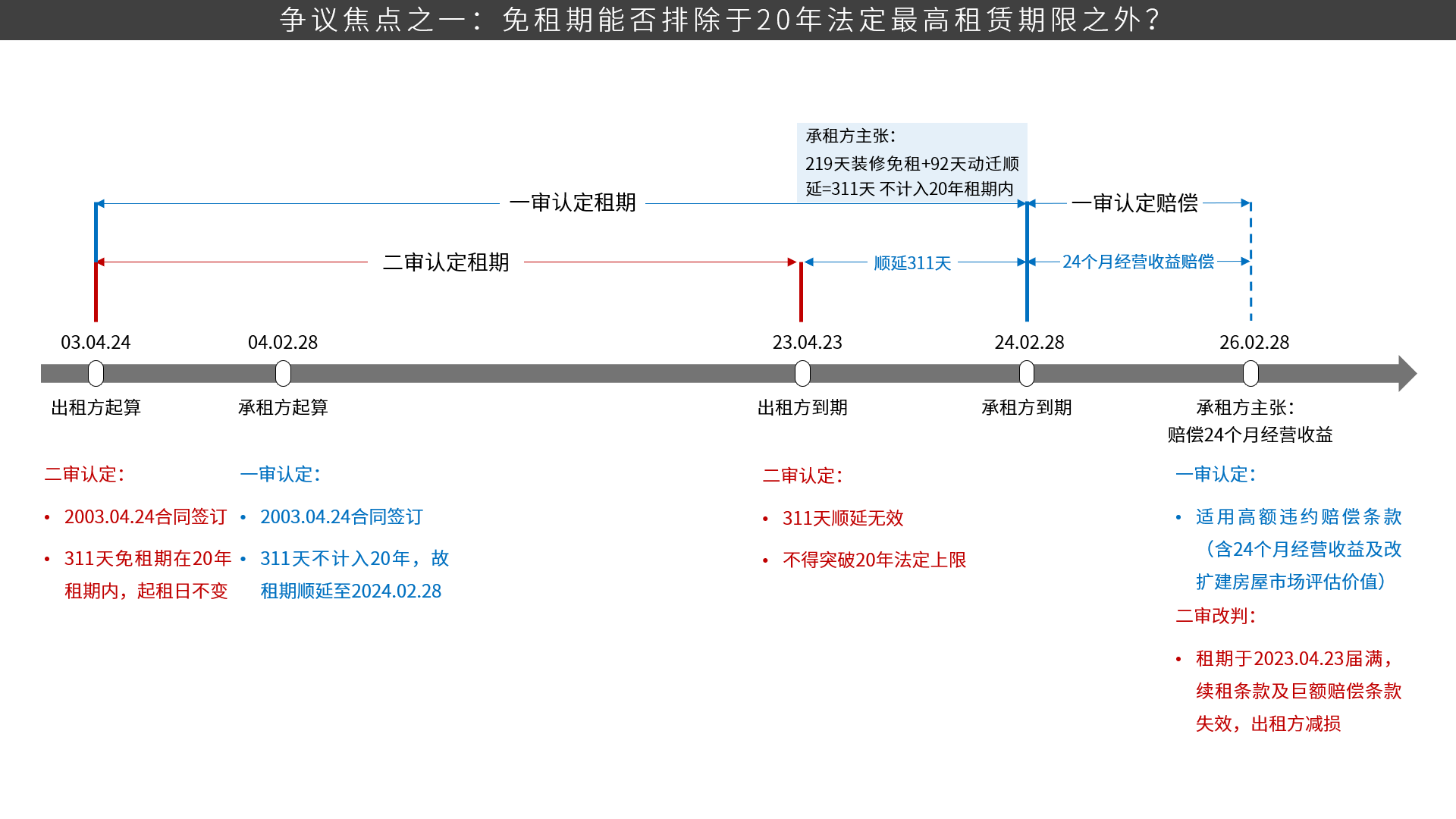
Around the expiration of the contract in 2023, a major dispute arose regarding renewal and site vacation, leading to litigation. The first-instance court ruled that after excluding and extending the rent-free periods, the lease contract should not terminate until February 2024, and the lessee was not in breach. Accordingly, the court ordered the lessor to pay a massive 190 million RMB in loss compensation, upheld the lessee’s right to receive 24 months of operating income (approx. 88 million RMB) as agreed upon lease expiration, and set the occupancy fee for the period of delayed vacation at the original contract’s extremely low rent (with slight annual increases, approx. 6 million RMB per year). The first-instance judgment left the state-owned construction company (lessor) in a desperate position: not only facing hundreds of millions in compensation but also anticipating an enforcement deadlock where the lessee would refuse to vacate due to the extremely low occupancy fee.
II. Key Points and Challenges
1. Complex historical legacy agreements and highly binding massive claim clauses
Multiple supplemental agreements signed over 20 years explicitly granted the lessee the right to unilaterally demand renewal under original conditions and stipulated that if the lessor reclaimed the property, they would face extremely high liabilities, including massive discounted compensation and two years of operating income.
2. Conflict in determining whether “rent-free period extensions” can exceed the statutory maximum lease term
The first-instance court excluded a total of 311 days of rent-free periods confirmed by both parties from the lease term and extended them, effectively pushing back the expiration of a contract that had already reached 20 years. Breaking this logic and proving the contract had expired was the core difficulty in terminating the lease relationship early.
3. The crisis of a severe inversion between occupancy fees and market value
Calculating occupancy fees based on the original contract rent, as the first instance did, not only severely deviated from objective market principles but also implicitly encouraged the lessee to breach the contract by overstaying to continue earning high profit margins. This caused the lessor’s actual economic losses to amplify over time.
III. Highlights of Representation
Zhenghan Law Firm was commissioned at a critical moment during the second instance. By precisely grasping the core threads of the case, they launched a “penetrative review” litigation strategy:
1. Reshaping lease term rules to terminate the contract early
The legal team keenly pointed out that the lessee had actually occupied and used the property during the rent-free period, which is essentially an inseparable part of the lease term. Any agreement to extend the rent-free period that causes the total lease term to exceed the 20-year statutory maximum under the Civil Code is invalid for violating mandatory provisions. This argument successfully persuaded the second-instance court to reverse the ruling, moving the contract termination date forward by nearly a year (to May 2023).
2. Striking at the root: Defeating automatic renewal and high liquidated damages
Regarding the basis for the 190 million RMB compensation in the first instance, the legal team hit the mark: the so-called “continuing cooperation according to existing agreed methods” is essentially equivalent to another 20-year renewal, which is invalid for violating the statutory limit. Since the renewal clause was invalid, the associated high-penalty clauses were also void from the start, effectively stripping away the basis for the other party’s unreasonable claims.
3. Restoring transactional fairness and significantly increasing occupancy fees
Through detailed case searches and comparisons with market rent standards, the team successfully proved that the first-instance reference to the original rent could not cover the lessor’s losses. They urged the second-instance court to adopt a unified calculation based on market assessment rent standards provided by a judicial appraisal institution. By significantly increasing the occupancy fee and moving up the contract termination date, they directly reduced the client’s losses by over 85 million RMB (provisional estimate) at the enforcement and settlement levels, completely turning the situation around.
IV. Key Points of the Judgment
The Shanghai No. 2 Intermediate People’s Court fully adopted Zhenghan Law Firm’s core arguments in its second-instance judgment, clarifying the following rules:
1. Although parties may agree on a rent-free period, the rent-free period does not detach from the lease relationship simply because rent is waived. Related extension agreements must not exceed the mandatory provision that “the lease term shall not exceed 20 years.”
2. Renewal clauses and related high-compensation clauses should be deemed invalid if they substantially violate the statutory maximum lease term. When a contract is invalid or cannot continue to be performed, relevant compensation should be based on residual value utilization under the lease relationship, rather than calculated according to the logic of expected real estate development returns.
3. While referencing the original contract rent to determine occupancy fees is a conventional approach, in cases where the original rent has clearly deviated from true market prices and cannot fully compensate the lessor’s losses, the occupancy fee for overstaying should be calculated according to market rent standards determined by an appraisal institution.
V. Case Insights
This case provides valuable guidance for resolving complex historical disputes in long-term commercial real estate and “lease-to-build” models. First, “rent-free period extensions” or “unconditional renewal” arrangements between commercial entities cannot cross the bottom line of the 20-year statutory maximum lease term; agreements exceeding this limit are absolutely invalid. Second, during the period of unauthorized occupancy after contract termination or invalidation, if the original rent significantly deviates from fair market value, the non-breaching party should dare to break convention and strongly advocate for occupancy fees based on market rent standards to cover actual losses. Third, when facing harsh or obviously unfair supplemental clauses formed during long-term cooperation, being adept at using mandatory legal provisions to conduct a penetrative review of their validity is a key breakthrough for reversing unfavorable trial outcomes.