Author Archives: wuyuqing@zhenghan.com

Zhenghan Law Firm’s Lawyer Wang Zheng Invited to Hong Kong to Share Practical Experience in Mainland Civil and Commercial Law

The 2025 Practical Course on Mainland Civil and Commercial Law, hosted by Hong Kong International Legal Talents Training Academy, was successfully held from June 13 to 14. As the first professional course of the academy targeting barristers, solicitors, corporate legal counsel and dispute resolution practitioners in Hong Kong, the event attracted approximately 300 legal professionals to register.

Paul Lam Ting-kwok, Secretary for Justice of the Government of the Hong Kong Special Administrative Region of the People’s Republic of China (left in the picture above), and Horace Cheung Kwok-kwan, Deputy Secretary for Justice (right in the picture above), delivered speeches at the opening and closing ceremonies respectively, pointing out that the course provides an important platform for the Hong Kong legal profession to gain an in-depth understanding of Mainland civil and commercial laws and practical operations, and is crucial for promoting exchanges and cooperation in the legal and dispute resolution fields between the two places.

With the core theme of “Deepening Understanding of Mainland Civil and Commercial Legal Practice and Empowering Cross-border Legal Services”, the course covered core areas such as the Mainland court system, Hong Kong-related intellectual property trials, and handling of foreign-related cases. Mainland judicial practice experts including Dr. Si Yanli, Deputy Director of the Research Office of the Supreme People’s Court and Senior Judge, and Dr. Wang Xiaoming, President of the Intellectual Property Tribunal of Guangdong Higher People’s Court and Senior Judge, jointly taught the course with renowned legal scholars and lawyers such as Professor Wang Liming, Vice President of China Law Society and First-class Professor of Renmin University of China, Professor Huang Jin, President of Chinese Society of International Law and Professor of the Institute of International Law and Global Governance of Wuhan University, Lawyer Wang Junfeng, Expert Member of the International Commercial Expert Committee of the Supreme People’s Court and Chairman of the “Belt and Road” Legal Service Alliance, and Lawyer Wang Zheng, Director of the Civil and Commercial Litigation Professional Committee of Shanghai Bar Association and Partner of Shanghai Zhenghan Law Firm.

Lawyer Wang Zheng of our firm was invited to share the core points of Mainland China’s dispute resolution on the first day of the course, focusing on the three major areas of preservation, evidence and enforcement. He compared property preservation measures between the Mainland and Hong Kong, for example, the measures of seizure, detention and freezing adopted in the Mainland are different from interim measures such as asset freezing orders in Hong Kong, introduced the “four-element theory” in the field of act preservation, and explained it with the “The Voice of China” injunction case as an example. He elaborated on the types of evidence and rules of burden of proof in the Mainland, analyzed the differences between common law and Mainland law in terms of standard of proof and discovery, and mentioned the mechanisms for mutual assistance in taking evidence between the Mainland and Hong Kong, Macao and Taiwan regions. He also explained the enforcement procedures, sanction measures and the crime of refusing to execute a judgment or order, emphasizing that dispute resolution solutions should be formulated from a cross-jurisdictional perspective.

The successful conclusion of the course marks a key step taken by the Hong Kong International Legal Talents Training Academy in promoting legal integration between the two places. In the future, the academy will rely on Hong Kong’s advantages of common law and Chinese-English bilingualism to continue cultivating compound legal talents for regions along the “Belt and Road”, and further consolidate Hong Kong’s position as an international legal and dispute resolution hub in the Asia-Pacific region.

Zhenghan Law Firm has long been deeply engaged in legal exchanges between the Mainland and Hong Kong, and has deeply participated in Hong Kong’s legal affairs with its Hong Kong office as an important platform. In the field of foreign-related legal services, Zhenghan Law Firm has achieved remarkable results, successfully handling a number of complex and major foreign-related cases covering cross-border dispute resolution, overseas equity disputes, international commercial arbitration and other fields, providing practical legal support and guarantee for numerous enterprises to “go global”. Previously, Zhenghan Law Firm was also invited to support the holding of the “2024 International Law Forum” in Hong Kong, and will continue to assist in the development of relevant legal activities in Hong Kong in the future. Through professional seminars and practical sharing, it will strengthen exchanges and cooperation with the Hong Kong legal community, and jointly contribute to promoting regional legal integration and improving the quality and efficiency of cross-border legal services.

Zhenghan Law Firm Listed in Benchmark Litigation 2025 China Dispute Resolution Rankings

Recently, Benchmark Litigation, an internationally renowned rating institution in the field of dispute resolution, released its 2025 China Dispute Resolution Rankings. Shanghai Zhenghan Law Firm was listed in the Shanghai Dispute Resolution – Commercial Disputes category, and Partners Ni Wei, Yang Runlai and Wang Zheng of Zhenghan Law Firm were awarded the title of Litigation Star.

Renowned for its leading dispute resolution practice in China, Zhenghan Law Firm has long represented a large number of complex and difficult commercial cases, cross-border dispute resolution cases, as well as market-oriented asset and debt restructuring cases including bankruptcy, providing professional dispute resolution services to large financial institutions, listed companies, governments and renowned enterprises. It has been consecutively awarded National Excellent Law Firm, Shanghai Top Ten Law Firm, and Chambers “Band 1 in Corporate and Commercial Law”; it has also won awards such as “Outstanding Law Firm in Domestic/Cross-border Dispute Resolution” and “Banking and Finance” by China Business Law Journal. Adopting the LockStep partnership model, Zhenghan Law Firm has built the entire firm into an integrated management team with clear professional division of labor to meet and exceed client service needs.

Zhenghan Law Firm Holds 2025 Open Day Event | 2026 Campus Recruitment Officially Launched

On May 23, 2025, the “Zhenghan Open Day” event was held at the firm’s Shanghai office. More than 40 student representatives from various universities gathered to gain an in-depth, zero-distance understanding of Zhenghan Law Firm and the dispute resolution field through a full day of series activities. This event also marked the official kick-off of the 2026 campus recruitment.

In the morning session of “Face-to-Face with Partners”, three partners delivered detailed analyses to the students from three perspectives: an introduction to Zhenghan Law Firm, core skills for lawyers, and career choices for law students.

Lawyer Wang Zheng gave a presentation titled *What Makes Zhenghan Law Firm Unique*, guiding the students to understand the firm’s distinctive features from the current industry landscape, development trends of dispute resolution practices, the firm’s unique corporate lock-step model, case types, and internal talent development systems.

Lawyer Zhang Wen lectured on *Core Skills of Lawyers in Complex Dispute Resolution*, introducing to the students how to cultivate the core competencies of a complex dispute resolution lawyer from five aspects: “Listen – understand and sort out objective case facts”, “Read – identify client needs and set litigation objectives”, “Analyze – conduct thorough legal research and formulate litigation strategies”, “Write – draft legal documents”, and “Speak – persuade clients and adjudicators through diversified approaches”.

Lawyer Yao Huiyun delivered a speech on *Career Choices for Law Students*, starting with the three questions “Who am I”, “What do I want to do”, and “What can I do” to help students analyze their career development directions. Meanwhile, by sharing the hardships and rewards of being a dispute resolution lawyer, she allowed the students to experience the real life of a legal practitioner.

During the subsequent lunch session, the firm carefully arranged trainees to accompany the students. Senior peers exchanged experiences with the students from the perspective of those of the same age and those who had walked the path, not only narrowing the distance between each other but also letting the students feel the joys and sorrows of being a newcomer in the workplace.

In the afternoon Lawyer Q&A session, Lawyers Xiao Yi, Zhu Siheng, Wang Chu and Li Tongyu, as representatives at different career stages, answered students’ questions, shared their professional experiences and life insights, and provided workplace problem-solving perspectives from different angles. At the same time, the lawyers also raised questions to the students, hoping to listen to the workplace demands and genuine thoughts of Generation Z, helping the firm keep pace with the times.

Finally, the Human Resources Department gave a systematic explanation of the firm’s talent growth system and recruitment process to the students.

This event marks the starting point of the 2026 campus recruitment. We firmly believe that young lawyers are the key variable driving the innovation of the legal industry. We hope to take this opportunity to help students gain a deeper understanding of the dispute resolution practice and the legal career path, and obtain some inspiration and encouragement as they are about to step into society. Meanwhile, we sincerely hope that more students will get to know us and join us.

The 2026 campus recruitment channel has been officially opened, and all students are welcome to actively submit applications. For other recruitment positions, please follow the job introductions to be released subsequently.

Zhenghan Law Firm Delivers Lectures on Complex Dispute Resolution at China University of Political Science and Law and Jilin University

Recently, Lawyer Wang Chu of Shanghai Zhenghan Law Firm was invited by China University of Political Science and Law and Jilin University respectively to deliver lectures on “Formulation of Complex Dispute Resolution Strategies” to law students of the two universities. Professor Liu Bin from China University of Political Science and Law; Professor Hu Xiaojing, Professor Yu Ying and Professor Wang Yanmei from Jilin University attended the lectures respectively.

From the perspectives of the three types of litigation subjects, namely parties, adjudicators and lawyers, Lawyer Wang Chu focused on explaining to the students how to formulate strategies around three aspects: factual evidence, substantive claims and procedural means. Taking cases he personally handled as examples, he interpreted the correlation between the formulation of strategies for complex disputes, case development and adjudication results, and illustrated the importance of strategy formulation in complex dispute resolution.

Lawyer Wang Chu’s sharing triggered profound thinking among many students. In the interactive session at the end of the lecture, a number of students raised their hands to ask questions and had in-depth exchanges with Lawyer Wang Chu. After the lecture, the participating teachers and students stated that the lecture was rich in practical content, highly instructive and practical, and provided guidance for the students’ future academic study and career planning.

Zhenghan Law Firm Conducts Training on Penetrative Debt Recovery and Shareholder Rights Preservation and Enforcement for AMC

On April 17, Wang Yang, Partner of Shanghai Zhenghan Law Firm, together with Lawyers Wang Chu, Sun Jia and Legal Assistant Luo Ziying, were invited by the Shanghai Branch of a state-owned non-performing asset management company (AMC) to deliver a special sharing session on “Penetrative Debt Recovery” and “Shareholder Rights Preservation and Enforcement” for multiple business lines including the Asset Department, Investment Department and the Legal & Compliance Department of the branch.

Topic 1 Penetrative Debt Recovery: How to Exhaust Debt Recovery Channels

In response to various debt recovery challenges such as debtor default and debt evasion frequently encountered in practice in recent years, with the goal of “exhausting all liable parties, all rights and all procedures”, Zhenghan Law Firm fully utilized various institutional tools including the new Company Law, Civil Code and Criminal Law, and introduced the macro thinking of creditors’ penetrative recovery from two aspects: “piercing the corporate limited liability” and “breaking the relativity of obligations”.

Combined with the business practice of non-performing asset disposal and starting from the actual debt recovery scenarios of creditors, Zhenghan Law Firm elaborated on six major categories of exhaustive debt recovery paths one by one, specifically including capital contribution, asset mixing, liquidation, preservation, tort and criminal categories. It also analyzed and addressed practical difficulties such as the basis of claim, exercise procedures and evidence collection and production under each path of penetrative debt recovery, fully demonstrating the firm’s rich experience in handling complex and major commercial dispute resolution cases.

Topic 2 The “Paths” and “Pitfalls” of Shareholder Rights Preservation and Enforcement

Shareholder rights preservation and enforcement involves the connection between judicial procedures, stock trading rules and regulatory standards, and relies on a variety of trading systems and processes, which is prone to conflicts and disconnections, making it a major practical difficulty in debt recovery. Targeting such “intractable problems”, Zhenghan Law Firm, based on its rich practical experience in property preservation and enforcement, systematically sorted out and introduced the practical key points of shareholder rights preservation and disposal: in terms of preservation, including the subject matter of preservation, assisting entities, effective time and preservation amount; in terms of disposal, including the types of shares, disposal methods and disposal prices, providing useful ideas and experience for creditors to smooth the “paths” of shareholder rights preservation and enforcement and avoid the “pitfalls” in preservation and disposal.

Renowned for its leading dispute resolution practice, Zhenghan Law Firm has long represented a large number of complex and difficult commercial cases, cross-border dispute resolution cases, as well as market-oriented asset and debt restructuring cases including bankruptcy, providing professional dispute resolution services to large financial institutions, listed companies, governments and renowned enterprises. It has been consecutively awarded National Excellent Law Firm, Shanghai Top Ten Law Firm, and Chambers “Band 1 in Corporate and Commercial Law”; it has also won awards such as “Outstanding Law Firm in Domestic/Cross-border Dispute Resolution” and “Banking and Finance” by China Business Law Journal. Adopting the LockStep partnership model, Zhenghan Law Firm has built the entire firm into an integrated management team with clear professional division of labor to meet and exceed client service needs.

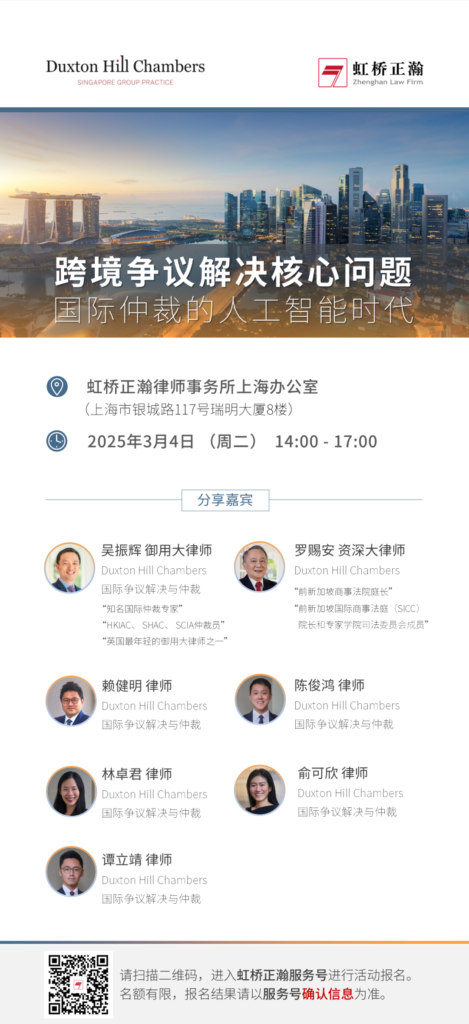
International Top Dispute Resolution Experts Invited by Zhenghan for “Core Issues in Cross-Border Dispute Resolution” Lecture

On March 4, 2025, global dispute resolution experts, including Ng Jern-Fei KC and Quentin Loh SC, were invited by Zhenghan Law Firm to give a lecture on “Cross-border Dispute Resolution Core Issues: The AI Era of International Arbitration.” The event attracted many legal professionals for in-depth discussions.

Theme 1: Introduction to Singapore’s Dispute Resolution Mechanism

Speaker: Quentin Loh SC, former Presiding Judge of the Singapore Commercial Court and Senior Counsel. In 2017, Loh SC was appointed as an Honorary Bencher of Middle Temple and in 2018, he was appointed as an Adjunct Judge of the Supreme Court of Fiji. In the same year, he was also appointed as the Patron of the Singapore Branch of the Chartered Institute of Arbitrators. In 2015, he was in charge of the formation of the Singapore International Commercial Court (SICC) and was appointed as the Presiding Judge and a member of the Judicial Committee of the Expert Academy in 2020.

Loh SC systematically introduced Singapore’s arbitration, mediation, and litigation systems. He focused on the establishment of the SICC in 2015. As a department of the High Court’s General Division and part of the Supreme Court of Singapore, its establishment aims to meet the growing demand for effective resolution of transnational disputes through litigation. It is characterized by efficiency, lower litigation costs, and a panel of foreign judges with diverse legal backgrounds to meet the requirements of different jurisdictions.

Theme Two: Appropriate Limit of Court Intervention in Arbitration

Speaker: Ng Jern-Fei KC. Ng KC became one of the youngest Queen/King’s Counsel in the UK in 2018 and was invited to participate in the fourth seminar of the International Commercial Expert Committee of the Supreme People’s Court on September 25, 2024. In addition, Ng KC is also a member of the arbitration panels of the Hong Kong International Arbitration Centre (HKIAC), Shanghai Arbitration Commission (SHAC), and Shenzhen Court of International Arbitration (SCIA).

Ng KC analyzed the case of BZW & Another v BZV from the Singapore Court of Appeal to discuss the issue of court intervention in arbitration awards. He pointed out that the court should maintain an appropriate limit when supervising arbitration awards, neither over-intervening nor completely indulging. Ng KC also discussed the limitations of the principle of minimal court intervention and emphasized the importance of appropriate court intervention in arbitration. He suggested that the court’s intervention in arbitration should evolve from the “principle of minimal intervention” to the “principle of appropriate intervention” to better balance the relationship between the court and the arbitration tribunal.

Theme Three: Analysis of the Evidence System in International Arbitration

Speaker: Nathaniel Lai, Lawyer. Mr. Lai focuses on handling complex commercial litigation and international arbitration cases and has obtained practicing qualifications in both Singapore and New York.

Mr. Lai delved into the importance of evidence in international arbitration, detailed the International Bar Association (IBA) Rules on the Taking of Evidence in International Arbitration, and provided a comprehensive and detailed explanation of document production, witness and expert evidence, among others, combined with actual cases. In addition, he shared strategies for dealing with confidential or politically sensitive documents and the adverse consequences of failing to produce documents as required. This lecture provided valuable knowledge and practical guidance for participants to better understand and deal with evidence issues in international arbitration.

Theme Four: Sacofa Sdn Bhd v Super Sea Cable Networks

Speaker: Tan Jun Hong, Lawyer. Mr. Tan specializes in commercial litigation, international arbitration, arbitration-related litigation, shareholder and company disputes, and has obtained practicing qualifications in Singapore, England and Wales, and New York.

Mr. Tan delved into his participation in the Sacofa case, focusing on how to resolve conflicting dispute resolution clauses in multiple contracts and the application of the issue estoppel principle in previous enforcement proceedings. Through actual cases, he detailed the importance of determining the “centre of gravity” of disputes in international arbitration and how to coordinate dispute resolution mechanisms across different legal jurisdictions. In addition, Mr. Tan also shared his insights on handling public policy objections and the issue estoppel principle, providing valuable legal practice guidance for participants.

Theme Five: Trends in Accelerated Arbitration Procedures: Fast Track, Highly Fast Track, and Simplified Procedures

Speaker: Z.J. Jennifer Lim, Lawyer. Ms. Lim focuses on international dispute resolution and arbitration business and is an arbitrator in accordance with ICC and SIAC rules, as well as the Global Co-Chair of the Young Council of the Singapore International Arbitration Centre (YSIAC Council). She has practicing qualifications in Singapore, New York, the UK, and Hong Kong.

Ms. Lim introduced the rise and development trends of the expedited procedure, highly expedited procedure, and simplified procedure. She pointed out that the core goal of the expedited procedure is to reduce time and cost, efficiently resolve small disputes, promote judicial accessibility, and improve overall efficiency. She analyzed the key features and practical challenges of the expedited procedure through specific data and cases.

Ms. Lim also discussed the rise of the highly fast track procedure, especially the newly released UNCITRAL Model Clause on Highly Expedited Arbitration 2024, which aims to shorten the time for making awards from 6 months in fast arbitration to 45 days. She emphasized that the practical challenges of the expedited procedure include procedural fairness risks, time pressure on the arbitration tribunal, and the risk of award revocation, so it is necessary to find a balance between efficiency and due process.

After the lectures, participants had in-depth exchanges with invited experts and Zhenghan lawyers.

The lecture provided legal professionals with an opportunity for in-depth exchange and learning, allowing participants to gain a deeper understanding of the key issues in cross-border dispute resolution. It not only improved the professional proficiency of the participants but also laid the foundation for future cooperation in the field of cross-border dispute resolution. We look forward to more similar activities in the future to jointly promote the continuous development of the field of cross-border dispute resolution.

Zhenghan Law Firm Top 10 Cases of 2024

In 2024, drawing on profound professional expertise, innovative strategic thinking, and unwavering dedication to practice, Zhenghan Law Firm continued to forge ahead in the field of complex commercial dispute resolution. We took on a series of highly challenging cases, strove for excellence at every turn, safeguarded our clients’ rights and interests, and achieved remarkable and hard-won results.

As in previous years, Zhenghan Law Firm has selected and released the “Top 10 Cases of 2024”, marking the fifth consecutive year we have published our annual Top 10 Cases since 2020 (click here to review Zhenghan Law Firm’s Top 10 Cases of 2023, 2022, 2021, and 2020).

This list embodies the wisdom and diligence of our legal team. It includes cutting-edge cases that set “national firsts”, complex cases spanning multiple areas such as cross-border coordination and civil-criminal crossover, and, most notably, landmark cases where innovative strategies turned the tide against unfavorable odds. These cases reflect Zhenghan’s outstanding strengths in teamwork, tackling tough cases, and embracing innovation. Below, we revisit these classic cases.

Zhenghan Law Firm Top 10 Cases of 2024 (in no particular order)

RMB 400 Million in Compensation, a Six-Year Legal Battle: Zhenghan Secures Victory for Client in Related Party Transaction Case Damaging Company Interests

Keywords: Related party transactions damaging company interests, identification of de facto controller, judicial authentication

Litigation over a de facto controller abusing a related party relationship to damage company interests is inherently challenging, especially regarding the identification of the de facto controller, uncovering concealed tortious acts, drawing the line between legitimate commercial transactions and torts, and quantifying damages. This case encapsulated all these difficulties: complex facts, hidden torts, and the destruction and concealment of key evidence by Lin prior to his criminal conviction, with remaining documents containing falsified data. Senior management involved in operations acted under Lin’s direction, with none cooperating to expose the truth. Upon being retained, Zhenghan immediately launched a case-specific analysis, deconstructing the transaction model to demonstrate its severe lack of commercial rationality. Our detailed arguments persuaded the court to order judicial authentication. Relying on the authentication report, the court ultimately ordered Lin and his affiliates to pay RMB 400 million in joint and several compensation.

From Pressure to Surprise: Reversal in a RMB 1.3 Billion Guarantee Contract Dispute

Keywords: Guarantee contract, civil-criminal crossover, pre-consent to continued guarantee, determination of contract effectiveness conditions

Our client extended a trust loan to a debtor, with a local state-owned enterprise providing a guarantee that included a clause of “pre-consent to continue guaranteeing any extension of the principal obligation”. When the trust loan fell due, the client filed suit. Disputes arose over the validity of the pre-consent clause, compounded by adverse factors: the client’s loan officer was involved in a criminal case, the principal debtor went bankrupt, the principal contract was subject to extension disputes, and the counterparty used local influence to interfere with fact-finding via criminal reports. Focusing on core legal issues, the team addressed the handling of civil-criminal crossover, the determination of contract validity where effectiveness conditions were disputed, and differences in pre-consent clauses before and after the enactment of the Civil Code. Emphasizing the commercial context and rationality of the guarantee, we successfully persuaded the appellate court to reverse the judgment and hold the guarantor liable for joint and several payment of the RMB 1.3 billion claim, recovering massive losses for the client.

Complex Financed Trade Case Involving Civil-Criminal Crossover and Bankruptcy: Precise Positioning and Coordinated Strategy Maximize Client Interests

Keywords: Financed trade, civil-criminal crossover, bankruptcy liquidation

Zhenghan successfully represented a client as the fund-outflow party in a complex financed trade dispute seeking recovery through litigation. The case was compounded by the inherent complexity of financed trade, intertwined civil-criminal legal issues, and the counterparty’s bankruptcy, presenting unprecedented challenges to recovery. Throughout the process, Zhenghan proceeded steadily, attending to every detail and closely monitoring case progress. At each stage, we conducted exhaustive analysis and pursued all available remedies, overcoming obstacles one by one. We ultimately obtained an effective judgment and assisted the client in recovering funds, fully demonstrating our efficient and professional capabilities in financed trade and civil-criminal crossover cases. Through precise legal strategies, we maximized the client’s interests.

A “Rashomon” Case: Complete Victory in an Eight-Year Battle for a Detached Villa

Keywords: Housing sales dispute, civil-criminal crossover, criminal risk mitigation, retrial by the Supreme People’s Court

Our client purchased a detached villa with full payment but faced repeated obstacles to performance, sparking an eight-year lawsuit. The case involved over RMB 100 million in complex fund flows, confused legal relationships, missing evidence, and interference from criminal case filings. Leveraging profound legal expertise and sharp insight, Zhenghan traced the fund flow, reconstructed the transaction truth, and established a clear factual framework. Facing the threat of criminal prosecution, we mounted a vigorous defense, successfully persuading the appellate court to order a resumption of proceedings and assisting public security authorities in concluding there was no criminal conduct. Over the lengthy litigation, we withstood the counterparty’s interference through first instance, appeal, and retrial by the Supreme People’s Court, and skillfully overcame enforcement objections. We ultimately secured full ownership of the villa for the client.

Innovative Enforcement via “Non-Harassment Agreement” Secures Return of Listed Company Shares for Client

Keywords: “Non-harassment agreement”, listed company equity dispute

The controlling shareholder of a listed company had signed a “non-harassment agreement” with an individual, promising to create commercial opportunities for the individual to acquire company shares in exchange for ending disruptive activities. The individual later harassed the company and sought profit during a private placement, prompting the controlling shareholder to retain Zhenghan to initiate arbitration. Our team meticulously organized evidence and vividly presented the facts, convincing the arbitral tribunal of the individual’s malicious breach. The tribunal ordered the return of listed company shares worth over RMB 70 million, protecting the client’s rights and the listed company’s normal operations. This case highlights Zhenghan’s expertise in handling unique contractual disputes and listed company equity conflicts.

Defeating a “Zero-Dollar Takeover”: Zhenghan Helps Client Realize Project Value in a Data Center Equity Transfer Dispute

Keywords: Equity transfer dispute, data center project, peer collaboration

Our client sold equity in a data center project company to another firm, which later sued to effect a “zero-dollar takeover” after project construction stalled. Retained to defend, Zhenghan conducted in-depth research into the data center industry, identified the counterparty’s fundamental breach, and filed a counterclaim for contract termination. In appellate mediation, our professional negotiation skills secured a settlement that enabled the client to fully realize the project’s value. A landmark case in the data center industry, it protected the client’s legitimate and vested interests and earned high client recognition. This case also reflects Zhenghan’s successful collaboration with peer firms, fostering synergy and creating substantial value for all parties.

Complete Appellate Reversal: Rules for Reviewing Legal Relationships in a Private Equity Fund Exit Dispute

Keywords: Private equity fund equity investment, equity in form but debt in substance, mixed contract, judicial disposal of shares

The core issue in this private equity exit dispute was whether the transaction constituted “equity in form but debt in substance”. Zhenghan thoroughly analyzed the investment structure, conducted exhaustive research on judicial views, cases, and academic theories, and secured a reversal at the Shanghai Higher People’s Court. The appellate court rejected the first-instance court’s piercing review of the contractual relationship, clarifying the legal review framework for private equity investments and shielding the fund manager from massive liability. In enforcement, we coordinated with multiple institutions to swiftly dispose of shares and dividends, recovering nearly RMB 100 million for the client. This case sets an important precedent for handling private equity fund exit disputes.

Insider Trading and Market Manipulation Across Multiple Jurisdictions: Comprehensive Mitigation of Administrative and Criminal Risks

Keywords: Insider trading, false representations, market manipulation, crossover of administrative and civil proceedings

This case involved insider trading and securities market manipulation, spanning administrative penalties, administrative litigation, civil enforcement, and criminal proceedings across multiple jurisdictions, addressing key and difficult issues in securities violations. Due to the confidentiality of the case, a dedicated professional research article will be published separately for readers.

Cross-Border Battle for Overseas Equity Worth RMB 10 Billion: Innovative Judicial Practice Filling Legal Gaps

Keywords: Interim injunctive relief in cross-border commercial cases, domestic court adjudication of overseas equity disputes

This case involved cutting-edge judicial practices in cross-border dispute resolution, including overseas equity disputes, parallel litigation, and interim injunctive relief. Despite ongoing overseas proceedings involving the overseas equity, Zhenghan persuaded a Chinese court to accept jurisdiction over the dispute and, in a breakthrough, obtained interim injunctive relief over the control of a series of domestic and overseas companies, safeguarding the client’s interests. Due to confidentiality, case details cannot be disclosed.

National First Case for Huge Reliance Interest Claims: Innovative Arguments Shield Client from RMB 300 Million Liability

Keywords: Third-party infringement of creditor’s rights, scope and definition of reliance interest

This national first case centered on huge reliance interest claims, involving the legal characterization of this niche area and the recognition of third-party reliance interests. With no clear legal or regulatory provisions, the dispute risked being decided by intuitive values rather than legal analysis. Departing from traditional tort reasoning, the team grounded arguments in the scope of civil rights and interests protected by tort law, successfully demonstrating that the plaintiff’s claimed interests fell outside tort protection. This innovative strategy showcased the team’s high-level capability in handling complex and novel cases, ultimately shielding the client from RMB 300 million in compensation.

These successful cases completed by Zhenghan Law Firm in 2024 fully demonstrate our profound professional knowledge, innovative strategic application, and tenacious spirit across all subfields of complex commercial dispute resolution. These achievements have delivered comprehensive, high-quality legal services to our clients and contributed practical experience to the legal industry. Nonetheless, we recognize that the pursuit of legal services is endless, and these cases represent only milestones on our journey. Going forward, Zhenghan will continue to strive for excellence, explore innovation, and enhance our professional capabilities and service standards to meet increasingly complex legal challenges. We will deliver even higher-quality and more efficient legal services to our clients and contribute to the sustainable development of the legal profession.

Has AI Made Knowledge Management Easier?

Has AI Made Knowledge Management Easier?

Nearly every lawyer cares about knowledge management. Lawyers have an innate hunger for knowledge—to know more, remember more, and apply their knowledge in more contexts. Yet knowledge management among lawyers is rife with misconceptions. From entire law firms down to individual teams and even solo practitioners, many have made mistakes and faced setbacks. You might have collected countless articles and practical tips that gather dust in your bookmarks; you might have painstakingly organized templates and workflows that no one uses or deems useful; you might have purchased a dozen note-taking apps, built one so-called knowledge management system after another, only to abandon them all and end up jotting things down in WeChat’s File Transfer Assistant. Now that DeepSeek, IMA, Kimi, Doubao and other AI tools have taken off, uploading all your files into them seems to have given knowledge management a new lease on life.

Below are several common misconceptions the author often hears—see if any strike a chord with you:

Misconceptions About Knowledge Management

Misconception 1: Setting overly ambitious goals for knowledge management

You often hear lawyers and law firms asking: How can we unify knowledge across the entire firm or entire team? How can we ensure everyone actually uses it? What constitutes a complete knowledge system? How can we standardize all knowledge formats? When your questions include words like “all,” “every,” and “complete,” and you envision a large, comprehensive, perfect system, you have set your sights too high. Overly ambitious goals lead to burnout before you even start, while overly rigid rules feel like dancing in shackles, growing heavier with every step. People are inherently lazy. When swamped with cases and projects, struggling to meet client demands as it is, how can you expect them to prioritize these important-but-not-urgent tasks?

Misconception 2: Spending excessive time on organization

Many lawyers invest massive amounts of time organizing knowledge: creating elaborate categories, assigning keywords and tags, building tree diagrams and nested folders, even arguing endlessly over a single directory structure for knowledge management. Some lawyers write lengthy manuals and operational guidelines, yet in daily practice, few lawyers actually read them carefully. Even if they do, they may not understand them; even if they understand, they may not follow them.

In reality, much knowledge may never be reused, since no two cases are identical. All too often, by the time you need it, new laws have taken effect or judicial interpretations have shifted, rendering much of your knowledge obsolete. For a great deal of information and knowledge, management may truly be a pseudo-problem. Knowledge management must also consider cost-effectiveness.

Misconception 3: Saving all materials equals knowledge management?

Many other lawyers skip the organizing step entirely: they download and save every article they see, hoping to use it someday. But this is equally useless. Saving is easy; mastering and understanding are hard; actual application is the greatest challenge of all. The more specialized an article, the narrower its focus, the more it consists of isolated, fragmented points—easily floating like duckweed on a stream, carried away without leaving a trace.

Misconception 4: Knowledge management requires choosing the perfect software?

The market is flooded with tools: a dizzying array of note-taking apps—old standbys like Evernote, Youdao Note, OneNote, and built-in phone memos; newer options like Notion, Obsidian, Wolai, Cubic, Flomo, not to mention various workflow and template tools.

But this approach is wrong! What matters is not the software, but the method or system! Software is merely a tool, a reflection of your approach. If your method is flawed, no software will fix it.

What Should Knowledge Management Achieve?

Leaving aside abstract concepts and returning to real-world scenarios, knowledge management ultimately exists to serve lawyers and law firms. So ask yourself: in what situations do you wish you had better knowledge management?

Scenario 1: Onboarding for Newcomers

You’ve never handled this type of case, researched this issue, or drafted/reviewed this document or contract—you wish you had a template, a mentor, or a practical guide to reference. Lawyers are quick learners, but time is often scarce when deadlines are tight and workloads heavy. Well-organized knowledge, contracts, and templates let new practitioners quickly build a framework in a field and get up to speed fast.

Scenario 2: Avoiding Critical Mistakes

Doing legal work well is hard; making mistakes is all too easy. Small errors range from typos and mindless copy-pasting that goes uncorrected, to substantive or procedural mistakes that are impossible to list exhaustively. Firms and lawyers often create handbooks or emphasize key warnings during onboarding to help young lawyers avoid missteps, much like a mistake notebook from school. The difference is that a school mistake notebook only costs a few points, while professional errors can mean losing client or judicial trust—or outright legal liability.

Scenario 3: Capturing Best Practices

Beyond avoiding mistakes, lawyers also summarize successful experiences: a case or project that delighted a client, a well-crafted contract (or other document), a highly effective court hearing, a well-received lecture… all deserve reflection on what worked, to serve as a foundation for even better performance next time. Of course, pre-organized track records also save enormous time during bidding and can tip the scales in your favor.

There are many other scenarios, such as breaking down knowledge silos in team or integrated management. In any case, you must identify which scenario’s knowledge you most want to manage first. Only by clarifying the scenario can you carry out targeted knowledge management.

How to Practice Knowledge Management?

There is no perfect method for knowledge management, but the following tips, drawn from the author’s years of experience, may prove helpful:

Tip 1: Align knowledge as closely as possible with your workflow

While guidelines and manuals are rarely used, the process of creating them is still highly valuable. It forces you to systematize and processize knowledge, drawing on experience and memory for deep reflection—something the end user does not experience. Thus, guidelines and manuals often benefit the creator more than the user.

How, then, to make knowledge fit your work better? Templates are an excellent tool. Lawyers’ work almost always produces documents as deliverables. Even for tasks requiring on-the-spot performance, such as hearings and negotiations, you can template the preparation—for example, hearing or negotiation outlines. All of these can be turned into templates.

The templates described here are not blank fill-in-the-blank documents, which offer little value beyond formatting. A good template includes detailed content and annotations. For content: a power of attorney could pre-include authorization language for different scenarios; a complaint could offer sample claims (for monetary payment, specific performance, damages, interest calculation, enforcement of security interests and priority, etc.). For annotations: notes can flag key considerations for each section, integrating guideline content directly into the final deliverable.

Beyond templates, consider the PARA framework. Short for Project-Area-Resource-Archive, PARA is a method for organizing information. It rests on two key assumptions: first, that information is nearly indestructible when stored in the cloud and accessible anywhere; second, that knowledge management therefore depends more on search within the system than on manual organization.

To learn more about the PARA method, see this book.

The method recommends grouping all ongoing work with a clear deliverable (e.g., a case, a lecture, an article) as a Project in the Project folder; all mid-to-long-term work in a specific domain without a fixed outcome but high importance (e.g., hiring, learning a skill, firm or bar association work) in the Area folder; long-term, interest-based information with no immediate use case (e.g., legal interpretations and monographs) in Resource; and completed materials no longer in frequent use in Archive. This system runs smoothly precisely because it aligns with workflow.

Tip 2: Build a knowledge tree and think structurally

I once read an article by Liu Run that divides knowledge into four layers: experience, lessons, methods, and theories. The earlier layers are concrete and specific; the later ones abstract and general. While raw experience matters, distilling lessons and methods from it is even more important. Beyond clarifying which layer your knowledge falls into, you should build a knowledge tree to integrate all lessons and methods coherently. Avoid fragmented learning—until you have built a system, all learning is wasted effort.

For example, different cases have different factual details, involving distinct claims and defenses, making it difficult to summarize a complete framework for litigation strategy. After participating in an in-firm course on dispute resolution strategy, I began to think systematically about the factors to consider in strategy design, their interrelationships, and specific methods to optimize strategies. Over time, new cases I handled and successful cases shared by colleagues continuously enriched the course materials, refining the system and embedding these lessons and methods in my mind. Every time I teach the course, these strategies are reactivated, remaining fresh and relevant.

Tip 3: Output is the best form of knowledge management

If you cannot explain something clearly, you do not truly understand it. Often, halting, unclear speech stems not from a clumsy tongue, but from muddled thinking. Speaking and writing are often the best forms of knowledge management, forcing you to think systematically and deeply. Mere writing or speaking is not enough; more importantly, you must organize knowledge with an audience in mind, giving it purpose—such as solving a problem in a specific scenario or for a specific group—so that it becomes genuinely useful.

For instance, in 2023 we collaborated with L-council on a course about statutory damages, liquidated damages, and deposits, prompted by many in-house counsel requesting training on these topics. Initially, we thought these were basic issues with little to cover, but as we organized the material, we realized a systematic review of the respective rules and interconnections was essential to offer meaningful insight. The final course spanned over 200 slides and two hours, receiving excellent feedback, and also allowed us to thoroughly research and structure a topic that arises in nearly every case but is rarely studied systematically. Without this opportunity, we might never have explored it so deeply.

Lecturing and writing each present distinct challenges. Lecturing demands immediate feedback and requires designing content to hold an increasingly distracted audience; writing, meant to be read and re-read, must be logical and systematic, and readily exposes gaps in detail.

In any case, output marks the start of real learning, and those who teach and write always gain more than their audience and readers.

Tip 4: Knowledge management can be as simple as “shouting”—use collective power

Knowledge is always personal and never fully objective. Many statutes you never truly understand until you apply them in a case, after which you gain entirely new insights. Hearing someone else explain something a thousand times is no substitute for doing it yourself. Moreover, since every case is unique, even the most thorough analysis by a previous lawyer rarely applies directly to a new matter.

Thus, rather than trying to turn research memos into generic, objective legal studies, it is better to ensure your team or firm knows what cases everyone has handled and what problems they have solved. Living knowledge in someone’s mind is more valuable than dead knowledge in a book. Knowing who has done what is often more important.

Internal experience and case sharing sessions, or even quick case updates, can therefore be highly efficient forms of knowledge management. Knowledge management can be as simple as calling out in the team or firm: “Has anyone handled XXXXX before?”

Tip 5: Understand and leverage AI

As noted earlier regarding software, in a sense, folders and Office may be the best knowledge management tools available. Find a sufficiently large, secure cloud drive, store all case materials properly, and summarize the key highlights and features upon closing—this may achieve 90% of effective knowledge management.

Looking ahead, AI is certain to disrupt and transform traditional knowledge management models. Many AI tools now offer knowledge base features, limiting output to content provided by the user. For firms and lawyers with existing knowledge repositories, this can drastically reduce time spent searching and summarizing information.

For example, if a firm has organized its past track records, AI can quickly identify relevant precedents from the database for a new business development pitch. If a firm regularly compiles research memos, AI can rapidly locate similar issues and conclusions when similar questions arise later, even generating a new conclusion directly based on the query.

Finally, I borrow a line from a peer at a Magic Circle firm I saw on social media: Done is better than perfect!


Quinn Emanuel, Zheng Han Law Firm & Shanghai Jiao Tong University Co-host Forum on Global Legal Risk Management for Chinese Enterprises in the Trump 2.0 Era

On January 9, 2025, the forum themed “Global Legal Risk Management for Chinese Enterprises in the Trump 2.0 Era” was successfully held at KoGuan Law School of Shanghai Jiao Tong University. The event was co-hosted by **Quinn Emanuel Urquhart & Sullivan, LLP**, Shanghai Hongqiao Zhenghan Law Firm, and Shanghai Jiao Tong University.

Dr. Tang Haiyan, Managing Partner of Quinn Emanuel’s Shanghai Office
Dr. John B. Quinn, Founder and Global Managing Partner of Quinn Emanuel—the legendary figure in the legal community—and Samuel G. Williamson, Founding Partner of Quinn Emanuel’s China Practice, attended the forum in person and delivered keynote speeches. The forum was opened with remarks by Xie Wei, Deputy Party Secretary of KoGuan Law School, and moderated by Dr. Tang Haiyan, Managing Partner of Quinn Emanuel’s Shanghai Office. Professor Shen Wei from KoGuan Law School, Ni Wei, Founding Partner of Hongqiao Zhenghan Law Firm, and Liu Xiao, Head of Quinn Emanuel’s China Practice, served as panelists. The forum brought together industry elites, including heavyweight guests from renowned domestic and international enterprises, law firms, and universities.

On behalf of KoGuan Law School, Deputy Secretary Xie Wei first extended a warm welcome to Mr. John B. Quinn, Mr. Samuel G. Williamson, and distinguished guests from all walks of life, and expressed gratitude to Quinn Emanuel and Hongqiao Zhenghan Law Firm for their support.

Deputy Secretary Xie Wei noted that amid ongoing global geopolitical volatility, the landscape and demand for legal services are undergoing profound changes. The future trends of legal services and the cultivation of cross-border legal talents in universities have become urgent topics for discussion. KoGuan Law School has always shouldered the important mission of cultivating legal talents with an international vision and cross-cultural communication capabilities. The advent of the Trump 2.0 era has undoubtedly brought new challenges and opportunities to the globalization strategies of Chinese enterprises. Strengthening the cultivation of cross-border legal talents and enhancing the internationalization of China’s legal services are urgent needs to serve the country’s opening-up strategy and safeguard national interests and corporate rights. She also emphasized that the gathering to explore ways of legal services and business practices in the new era is a rare opportunity. Under the theme of today’s forum, the rich experience and unique insights of the guest speakers will reveal new trends in legal services and risk management in this era, providing valuable strategic guidance and practical advice for Chinese enterprises.

John B. Quinn, Founder and Global Managing Partner of Quinn Emanuel, delivered a keynote speech on “The Trend of Legal Services Under the New Global Geopolitical Landscape”. John first briefly introduced Quinn Emanuel’s unique global development history focusing on dispute resolution. He shared many cross-border dispute resolution cases handled by Quinn Emanuel: regarding the most troublesome enforcement issue in cross-border disputes, in an international arbitration case between a British company and the Indian government, Quinn Emanuel successfully compelled the Indian government to comply with an arbitration award of US$1.8 billion by promoting the seizure of Indian government aircraft in the United States; facing complex disputes spanning multiple jurisdictions, Quinn Emanuel represented Samsung in litigation against Apple across 18 jurisdictions, fully demonstrating the higher requirements for law firms’ cross-jurisdictional dispute resolution capabilities in the era of globalization; in addition, diversified dispute resolution methods still play an important role in cross-border dispute resolution. During the financial crisis, Quinn Emanuel represented small domestic and foreign banks and individuals in disputes with major Wall Street banks, winning over US$50 billion through settlements and other means; finally, John mentioned that super individuals such as Elon Musk have a unique influence and role in cross-border dispute resolution in the era of globalization. Quinn Emanuel represented Elon Musk in a Tesla-related false statement case, in which Musk’s personal remarks on social media were key to his liability. After the court ruled that the remarks constituted false statements, Quinn Emanuel made a breakthrough by demonstrating that the remarks did not cause a material impact based on the stock market’s reaction to the remarks, achieving a successful victory.

John stated that Quinn Emanuel believes the trend of globalization is irreversible, and the number of cross-border dispute resolution cases in intellectual property, the Internet, and other fields will continue to increase. Quinn Emanuel opened its first office in mainland China a decade ago and has now expanded to two. At a time when foreign law firms are uncertain about the Chinese market, Quinn Emanuel is increasing its investment in China. In the post-pandemic era, governments around the world have undergone tremendous shifts in policy attitudes, and more and more Chinese enterprises are going global. Reducing and addressing the legal risks involved requires professional legal services from more law firms to escort them. Quinn Emanuel has represented numerous Chinese state-owned and private enterprises in cross-border litigation, including criminal and civil-commercial litigation, covering intellectual property, trade secrets, government investigations, arbitration, and general commercial litigation. He cited the case of BGI Group winning over US$300 million in an intellectual property dispute in the United States to illustrate that Chinese enterprises can obtain fair and impartial judgments in the United States.

John also reminded that what Trump says and does are often inconsistent. During his previous term, he made many exaggerated remarks, but his actions remained within a rational scope. It is not difficult to see that Trump is a businessman who is willing to reach deals he deems beneficial, so his actions are still predictable. We believe that during his term, the United States and China are still likely to reach extensive trade cooperation including intellectual property protection.

Samuel G. Williamson, Founding Partner of Quinn Emanuel’s China Practice, shared his insights on “Strategic Restructuring and Legal Risk Management for Chinese Enterprises in the Trump 2.0 Era”. Sam specializes in government enforcement and investigations in Asia, as well as U.S. litigation involving Asian facts and parties. He is also a former federal prosecutor who served as a White Collar Crime Coordinator at the U.S. Department of Justice, and is the only former U.S. federal prosecutor who speaks Chinese and has lived in China. He vividly shared his connections with Hongqiao Zhenghan Law Firm and Shanghai with the attendees in Chinese.

Sam believes that the policy direction of the Trump administration in the next four years in the United States is full of uncertainties. He mainly reminded Chinese enterprises of the legal risks they face in the United States through personnel changes, introducing and analyzing the ideological backgrounds and professional experiences of key U.S. judicial nominees of the Trump administration, including the Attorney General, Secretary of Defense, and National Security Advisor, as well as their attitudes toward China and potential impacts. With his rich professional experience and in-depth understanding of the Asian market, Sam provided valuable suggestions for enterprises to cope with various uncertain challenges, including strengthening document retention and information archiving, improving supply chain transparency, and managing legal risks for overseas employees.

In the panel discussion session, Professor Shen Wei from KoGuan Law School, Lawyer Ni Wei, Founding Partner of Hongqiao Zhenghan Law Firm, and Lawyer Liu Xiao, Head of Quinn Emanuel’s China Practice, conducted in-depth exchanges on national security and compliance of Chinese enterprises, legal service management of law firms under the new situation, and litigation strategies for cross-border dispute resolution.

Corporate legal directors and colleagues from law firms also raised questions on the lecture content, and the forum guests held heated discussions and exchanges.

John B. Quinn, Founder of Quinn Emanuel Urquhart & Sullivan, LLP, and His Delegation Visit Hongqiao Zhenghan for Exchange and Discussion On January 13, 2025, John B. Quinn, founde

On January 13, 2025, John B. Quinn, founder of Quinn Emanuel Urquhart & Sullivan, LLP (Quinn Emanuel), and his delegation were invited to visit Hongqiao Zhenghan, where they held in-depth discussions on Sino-US dispute resolution legal services and law firm management. The session also welcomed dispute resolution partners from Fangda Partners, Clifford Chance, Hui Zhong Law Firm, King & Wood Mallesons, JunHe, AllBright Law Offices, and Lifeng Law Firm for exchanges and sharing. Lawyers Ni Wei, Wang Zheng, Qian Qian, and Liu Fengchang, partners of Shanghai Hongqiao Zhenghan Law Firm, attended the discussion.

John B. Quinn, Founding and Global Managing Partner of Quinn Emanuel, introduced the history and development of the firm. Since its establishment in 1986, Quinn Emanuel has grown from a small firm with only four lawyers to a renowned international firm with 1,200 lawyers across 36 offices worldwide, driven by its relentless pursuit of excellence in service and proactive market promotion. It specializes in dispute resolution, particularly in cross-border litigation, international arbitration, and government investigations. With its professional expertise and strength, especially in patent practice in Silicon Valley and financial litigation in New York and London, Quinn Emanuel has won the trust of numerous clients.

Samuel G. Williamson, Founding Partner of Quinn Emanuel’s China team, focused on the firm’s business development in China. He noted that Quinn Emanuel set up an office in Shanghai years ago, dedicated to providing Chinese enterprises with legal services in the United States. In the fields of dispute resolution and compliance services, Quinn Emanuel has successfully assisted many Chinese enterprises in addressing legal challenges in the US through its extensive experience, such as representing DJI in response to CMC sanctions and representing several Chinese banks in US litigation.

Against the backdrop of the Trump administration’s potential tough stance on Chinese enterprises in trade, intellectual property, export controls, and other areas, Samuel G. Williamson analyzed the legal risks that Chinese enterprises may face and proposed countermeasures. He emphasized that Chinese enterprises should prepare in advance and establish a sound compliance system to tackle challenges including complex production requirements, data security protection, and improved supply chain transparency. John B. Quinn added that despite the severe situation, Chinese enterprises are fully capable of reducing legal risks and safeguarding their legitimate rights and interests through sound legal strategies such as legal opinions and compliance programs.

In the interactive session, Chinese and US lawyers in attendance held heated discussions on topics including the differences between the Chinese and US legal service markets and the legal risks faced by Chinese enterprises in the US. John B. Quinn and Samuel G. Williamson shared their valuable experience and unique insights in handling cross-border legal matters, highlighting the crucial role of flexibility and innovation in legal practice. All participating lawyers expressed a positive attitude toward further strengthening cooperation and looked forward to joining hands to tackle more challenges in the future.

Shanghai Hongqiao Zhenghan Law Firm and Quinn Emanuel Urquhart & Sullivan, LLP have accumulated rich successful experience through long-term exchanges and cooperation. It is expected that the two sides will continue to expand areas of cooperation, provide more comprehensive and professional legal services for Chinese enterprises going global, and jointly support Chinese enterprises in forging ahead steadily on the international stage.