Archives

Hongqiao Zhenghan, After Seven-Year Rights Defense, Obtains Supreme Court Support, Setting a Precedent for Enforcement Objection Litigation in Cases of “No Written Distribution Plan”

HongQiao ZhengHan represented Bank A in a seven-year rights protection campaign against the enforcement court’s unauthorized distribution of case funds without preparing a written distribution plan during the enforcement distribution procedure, which has recently yielded fruitful results. Through the retrial procedure of the Supreme People’s Court (the “SPC”), HongQiao ZhengHan successfully revoked the original second-instance ruling dismissing the lawsuit, and the SPC ordered the second-instance court to hear the case. The case has clarified the judicial criterion that procedural defects shall not deprive parties of their substantive remedy rights, opening up a solid path for rights protection for creditors encountering similar unfair enforcement distributions.

Keywords: SPC Retrial, HongQiao ZhengHan, Turning Defeat into Victory, Action Challenging Enforcement Distribution Plan, Procedural Justice, Remanding for Retrial, Protection of Priority Claims

I. Basic Facts of the Case

Bank A is the first-ranking mortgagee of the real estate involved in the case. During the enforcement distribution process, an intermediate people’s court in western China failed to prepare a written distribution plan in accordance with the law, ignored Bank A’s multiple objections, arbitrarily reduced the amount of Bank A’s priority claims, and distributed the substantial remaining auction proceeds to ordinary creditors. After representing Bank A in pursuing rights protection through various procedures including enforcement objection, reconsideration of enforcement objection, and procuratorial supervision, HongQiao ZhengHan finally filed an action challenging the distribution plan with the intermediate people’s court, but the case was procedurally dismissed by the high people’s court of the province (the second-instance court) on the ground that “the enforcement court did not issue a written plan, which does not meet the statutory conditions for case acceptance”.

II. Key Points and Difficulties

This case fell into a highly prevalent legal dilemma: the law stipulates that “a lawsuit may be filed if there is an objection to the distribution plan”, but if the enforcement court acts illegally by failing to issue a written distribution plan in the first place, does the creditor thus have no access to remedies? After the action challenging the distribution plan was accepted, the mechanical adjudication of the second-instance court trapped the creditor in a logical loop of “losing the right to sue due to the enforcement court’s prior illegal act”. The keys to resolving the deadlock in rights protection in this case were: how to get the court to accept the action challenging the distribution plan in the absence of a written distribution plan; and how to push the SPC to break through the formalistic constraints of the provisions and recognize the justiciability of the “de facto distribution plan”.

III. Highlights of Representation

Representing Bank A, HongQiao ZhengHan embarked on a seven-year journey of rights protection, exhausting all available paths for safeguarding rights, specifically including:

(1) Filing an enforcement objection with the intermediate people’s court, requesting the issuance of a distribution plan, which was dismissed by ruling.

(2) Dissatisfied with the dismissal ruling, applying for reconsideration of the enforcement objection to the high people’s court of the province, requesting the revocation of the dismissal ruling and ordering the intermediate people’s court to issue a distribution plan. The high people’s court of the province revoked the dismissal ruling but held that a distribution plan had been issued through the actual distribution act, and Bank A could file an action challenging the distribution.

(3) As the intermediate people’s court still refused to accept the action challenging the distribution, applying for enforcement supervision to the people’s procuratorate at the same level as the intermediate people’s court, which issued a procuratorial suggestion to correct the procedural illegality.

(4) Based on the procuratorial suggestion, the intermediate people’s court accepted Bank A’s action challenging the distribution plan, and the first-instance court upheld all of Bank A’s priority claims.

(5) The defendant appealed against the judgment, and the high people’s court of the province procedurally dismissed Bank A’s lawsuit on the ground that “the enforcement court did not issue a written plan, which does not meet the statutory conditions for case acceptance”.

(6) Dissatisfied with the second-instance dismissal ruling, HongQiao ZhengHan represented Bank A to file a retrial application with the SPC.

During the SPC retrial stage, HongQiao ZhengHan adopted a breakthrough strategy of “substantive rights protection”. In the desperate situation where the lawsuit was dismissed in the second instance and remedy measures were almost interrupted, it accurately refined the principle of “functional equivalence” and insisted that the enforcement court’s procedural illegality should not be borne by the law-abiding creditor. HongQiao ZhengHan argued from multiple dimensions that the enforcement court’s multiple enforcement acts had the substance of distribution, and Article 509 of the Interpretation of the Supreme People’s Court on the Application of the Civil Procedure Law of the People’s Republic of China did not limit the conditions for filing an action challenging the distribution plan to a “written distribution plan”, successfully persuading the collegial panel that procedural defects should not be a reason for depriving substantive rights. Ultimately, the SPC issued a reversed ruling, revoking the original ruling and ordering the high people’s court of the province to conduct a substantive hearing.

IV. Key Adjudication Points

The SPC adopted HongQiao ZhengHan’s representation opinions and clearly stated:

Substantive Functional Equivalence: Although the enforcement court did not prepare a formal plan, it clarified the distribution order and amount through documents such as replies and case closure notices, which functioned as a “de facto distribution plan”.

Priority in Protecting the Right to Sue: The enforcement court’s procedural illegality should not be an obstacle to the parties’ exercise of remedy rights, and the court should substantively resolve disputes.

Revocation of Ruling and Ordering Trial: The second-instance ruling constituted an error in application of law, and the second-instance court was ordered to conduct a substantive hearing to safeguard the creditor’s statutory remedy rights.

V. Case Implications

This case is of great reference significance for financial institutions and the general creditor community: when encountering unfair distribution caused by the enforcement court’s “arbitrary acts” or “inaction”, do not be deterred by “formal requirements”. Even without a nominal “plan”, as long as distribution facts exist, creditors can safeguard their rights through professional legal strategies. This ruling of the SPC has set a benchmark for enforcement distribution disputes across the country where “no access to sue” is encountered, ensuring that creditors’ priority right to repayment will no longer be frustrated due to defects in enforcement procedures.

Second-instance reversal: HongQiao ZhengHan, litigating away from home, recovers hundreds of millions in investments from a local government investment platform.

This case involves a complex real estate cooperative development dispute concerning a local government resettlement housing project, with the core controversy focusing on the calculation of losses after the contract was deemed invalid. The case was under the jurisdiction of the court located in the place where the local government is situated. HongQiao ZhengHan represented the project investor and the engineering construction and management agent, while the opposing party, the project owner, was a local government platform company. The first-instance court only upheld the party’s claim for the return of the investment principal and determined that the local government platform company had suffered losses amounting to over 100 million yuan. Through rigorous and meticulous courtroom argumentation and detailed post-trial communications with the judges, HongQiao ZhengHan successfully persuaded the second-instance court to re-determine the losses, not only revoking the unfavorable first-instance judgment but also helping the client fully withdraw from the project led by the local government platform, recovering hundreds of millions of yuan in investment principal, interest and damages, thus achieving a complete reversal.

I. Basic Facts of the Case

The Appellant (Original Plaintiff), Company A (the project’s construction and management agent), entered into a real estate cooperative development agreement with the Appellee (Original Defendant), Company B (a local government platform company and the project owner), stipulating that Company A would invest in and construct a local resettlement housing project. During the project’s construction, a dispute arose between the two parties, and the agreement in question was ultimately characterized by the court as a construction project contract and deemed invalid in a separate effective judgment due to the project’s violation of the mandatory provisions of the Tendering and Bidding Law.

As the project could not proceed further, Company A had already incurred substantial upfront costs and faced huge losses. Accordingly, Company A filed a lawsuit with the court, demanding that Company B return Company A’s investment funds and compensate for losses arising from the occupancy of funds, as well as reimburse Company A for upfront investment cost losses. Company B, through a counterclaim, asserted that it had also suffered losses and demanded that Company A bear liability.

The first-instance court upheld Company A’s claim for the return of the investment principal but completely dismissed Company A’s request for losses arising from the occupancy of funds. Meanwhile, it included all expenses incurred by Company B using the investment funds provided by Company A as part of Company B’s losses, resulting in a final determination of Company B’s losses of up to over 100 million yuan, even though Company B’s counterclaim only sought more than 20 million yuan. Since the court’s judgment allocated and offset the losses of Company A and Company B in proportion to their respective faults, Company A was required to make additional payments to Company B for losses beyond the investment funds, placing Company A in an extremely unfavorable position.

II. Key Points and Difficulties

1. The opposing party had a government background, making litigation away from home extremely challenging

The opposing party, Company B, was a platform company backed by the local government, and the project involved a major local livelihood project (resettlement housing construction). Litigation was conducted in the local court, and an unfavorable judgment had already been issued in the first instance. Overturning the original findings on appeal faced enormous pressure from the opposing party’s “home-court advantage.”

2. The complexity of proving losses

As the investor, Company A had invested a large amount of upfront costs in the project, whereas Company B, as the owner, had actually invested very little in the project. The first-instance court mechanically applied the law, excluding a significant portion of Company A’s actually incurred expenses on the grounds of insufficient relevance of evidence, and instead recognized expenses that Company B had not even raised in its counterclaim as losses. Another major difficulty was how to construct a complete chain of evidence and logic in the second instance to reduce the opposing party’s loss amount and increase our client’s loss amount.

3. The fault game after the contract was deemed invalid

It was an established fact that the contract in question was deemed invalid due to a violation of the Tendering and Bidding Law. The difficulty lay in how to argue that Company A, as the investor and construction/management agent, was less at fault than Company B, as the owner, thereby reducing the proportion of fault liability borne by Company A.

III. Highlights of Representation

1. Detailed communication and professional argumentation reshaped the judges’ inner conviction

Faced with the opposing party with a government background, the acting lawyers persuaded the judges through multiple rounds of professional, detailed and well-organized communications both in court and after the trial to recognize that the court should not adjudicate beyond the claims or recognize losses exceeding the amount claimed in Company B’s counterclaim.

2. Visual charts clearly presenting the specific composition of losses

The legal team produced detailed visual charts that corresponded the complex project costs with thousands of pages of evidence, clearly presenting the name, amount, payment date, etc., of each expense, and strongly proved that Company A’s expenditures were directly related to the project and should be recognized as losses.

3. Precisely identifying the liable subject and reducing the proportion of fault liability

The legal team conducted in-depth legal research on the issue of liability for invalidity of a contract due to failure to tender when required, and provided a legal research report for the judges’ reference. During the trial, through rigorous logical deduction, the team clarified to the judges that Company B, as the employer and the government-backed party, held an absolutely dominant position in the project, and its “failure to tender when required” was the fundamental cause of the contract’s invalidity; Company A, as the bidder, had no right to decide on the tendering and bidding procedures and should not bear primary liability.

4. Arguing vigorously and persuading the court to uphold claims for losses arising from fund occupancy

Regarding the fund occupancy fees dismissed in the first instance, the acting lawyers cited the latest judicial interpretations to argue that even if the contract was invalid, losses arising from fund occupancy should still be compensated. Ultimately, the second-instance court upheld the fund occupancy interest calculated based on the Loan Prime Rate (LPR).

IV. Key Adjudication Points

1. Fault determination for an invalid contract

In a case involving the invalidity of a real estate development contract subject to mandatory tendering, the employer (tenderer) is obligated to organize the tendering and bidding process. Its failure to tender in accordance with the law leading to the contract’s invalidity shall bear primary fault liability.

2. Scope of compensation for losses

Compensation for reliance interest losses shall cover the necessary expenses incurred by the parties in performing the contract, including upfront start-up fees, management fees and project investments, and shall not be limited to the actual project construction cost. Meanwhile, the court’s determination of losses shall not exceed the scope of the claims raised in the plaintiff’s complaint or the defendant’s counterclaim.

3. Nature of fund occupancy fees

After a contract is deemed invalid, the compensated losses shall include interest losses during the period of fund occupancy.

V. Case Implications

This case is a typical example of disputes arising from social capital’s participation in local government infrastructure projects. For investors, it is essential to attach great importance to the compliance of tendering and bidding procedures in the early stages of a project; otherwise, once the contract is deemed invalid due to procedural violations, they will face huge risks in claiming compensation. At the same time, the second-instance reversal in this case also demonstrates that through the precise analysis of legal issues by professional lawyers, even when facing a powerful local government platform company, one can still protect their legitimate rights and interests through judicial channels. This case provides important reference significance for the liability settlement after the invalidity of contracts in similar “government-enterprise cooperation” projects.

Second-instance victory against all odds: HongQiao ZhengHan assists in overturning the finding of equity “nominee holding” in a family enterprise.

Recently, in a shareholder qualification confirmation lawsuit heard on second instance by the Shenzhen Intermediate People’s Court, represented by the Guangzhou Office of HongQiao ZhengHan, the first-instance judgment was reversed, resulting in a victory against all odds. Against the backdrop of a family enterprise’s entrepreneurial history spanning nearly three decades, the majority shareholder (elder brother) sued the minority shareholder (younger brother) on the grounds of “nominee holding”, demanding confirmation that the minority shareholder’s equity was held in trust for the majority shareholder. The first-instance court ruled to confirm the “nominee holding” and upheld the majority shareholder’s claims. Faced with an extremely unfavorable situation, the Guangzhou Office of HongQiao ZhengHan was invited to intervene in the second instance and represent the minority shareholder. After intense litigation between the two parties, HongQiao ZhengHan dedicated itself to reconstructing and restoring the facts of shareholding, refuting the majority shareholder’s “nominee holding” narrative. Ultimately, the Shenzhen Intermediate People’s Court, on second instance, overturned the finding of a “nominee holding” agreement in the first-instance judgment, ruled that the minority shareholder did not constitute nominee holding, and preserved the family enterprise equity worth hundreds of millions of yuan for the minority shareholder.

I. Basic Facts of the Case

The family enterprise was co-founded by two brothers in Shenzhen in the 1990s. After years of development, it grew into a well-known enterprise with assets exceeding one billion yuan. At the company’s inception, the elder brother, as the majority shareholder, held 70% of the equity, and the two brothers arranged four companies to act as registered nominal shareholders to hold the remaining 30% equity actually belonging to the younger brother, who, as the minority shareholder, had not been publicly named as a shareholder before. Later, the younger brother acquired back the 30% equity from the aforementioned four corporate shareholders at zero consideration. The company then underwent two rounds of capital increases, and the 70-30 shareholding ratio between the two parties has remained unchanged to this day.

Since 2019, conflicts have arisen between the two brothers. The elder brother filed a lawsuit for shareholder qualification confirmation, claiming that the 30% equity held by the younger brother was held in trust for him. The first-instance court held that although the two parties had not signed a nominee holding agreement, after comprehensively examining various factors such as the “intent for nominee holding”, “source of capital contributions”, and “exercise of shareholder rights”, and conducting layered argumentation, it determined that the equity constituted “nominee holding”. It found that the 30% equity at the time of the company’s establishment was held by four companies as nominees arranged by the elder brother, and the younger brother’s acquisition of the equity at zero consideration should be regarded as part of the elder brother’s nominee holding arrangement. Even the capital increase funds paid by the younger brother’s account to the company were deemed to be “bridge funds” provided by the elder brother rather than the younger brother’s own funds. Finally, the court ruled that the 30% equity registered in the younger brother’s name belonged to the elder brother, meaning the younger brother faced the desperate situation of losing his lifelong efforts and having his massive equity assets reduced to zero.

After the younger brother filed an appeal, out of deep concern over the potentially unfavorable outcome of the final instance, he sought out the Guangzhou Office of HongQiao ZhengHan upon reputation and entrusted the firm to represent him in the second instance.

II. Key Points and Difficulties

1. Nearly three decades of time span, making fact restoration difficult

The equity dispute involved in the case spans nearly three decades. Many key facts occurred in the distant past, and the collection of relevant evidence was arduous, posing a great challenge to the complete restoration of the case facts.

2. The opposing party was the controlling shareholder, making it difficult to overturn the appearance of nominee holding

The elder brother served as the company’s chairman, held operational decision-making power, and focused on finance in the internal division of labor. The indications of capital contributions at the time of the company’s establishment in the 1990s and subsequent capital increases were unfavorable to the younger brother, and the elder brother had an advantageous appearance of “nominee holding”. It was extremely difficult to破解 and prove that the younger brother actually performed shareholder obligations including capital contributions and exercised shareholder rights.

3. Non-standard operation of the family enterprise, leading to ambiguous legal relationships

The enterprise involved was a typical family enterprise without a sound financial system and governance mechanism in its operation and management, resulting in relatively vague core facts such as the source of capital contributions and profit distribution in the first-instance evidence presentation.

4. Defeat in the first instance and other related cases, making second-instance reversal extremely difficult

Other shareholding companies of the younger brother were also sued by the elder brother for nominee holding, and effective judgments from courts in other regions had already found that the younger brother held equity as a nominee for the elder brother. The younger brother had suffered successive defeats, making the reversal of the case in the second instance extremely challenging.

III. Highlights of Representation

1. Reconstructing and restoring facts to refute the “nominee holding” claim

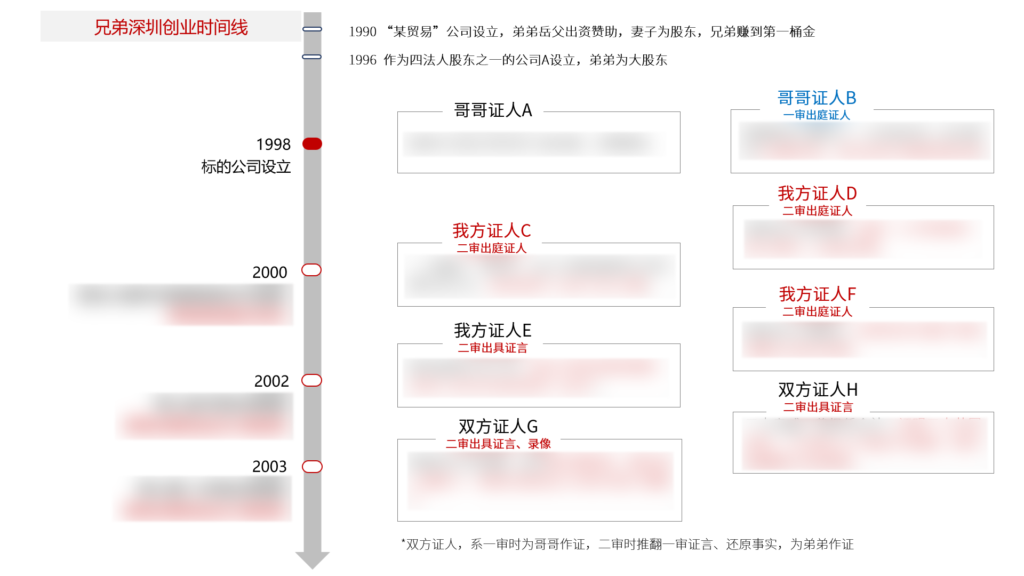
By thoroughly sorting out the nearly three decades of entrepreneurial history of the two brothers and collecting a series of evidence in the process, HongQiao ZhengHan vividly restored the enterprise’s years of development from the entrepreneurial stage, equity transfer stage, capital increase stage, growth to the outbreak of conflicts, sorted out multiple doubtful points in the first instance, and successfully persuaded the collegial panel to understand and accept that the true intention of both parties had always been joint entrepreneurship and shareholding.

2. Focusing on capital contribution liability and highlighting the opposing party’s flaws in evidence presentation

In the second-instance stage, HongQiao ZhengHan closely adhered to the provisions of the Company Law and relevant judicial interpretations, pointing out that the majority shareholder failed to provide sufficient evidence to prove that he had actually performed the original capital contribution and subsequent capital increase obligations corresponding to the 30% equity, that there were major flaws in the evidence chain and no logical closed loop was formed. In particular, it was pointed out that the majority shareholder claimed that the capital contributions came from companies actually controlled or held by him, but as a legal person, a company has independent property. The funds transferred from the majority shareholder’s controlled companies to the minority shareholder’s account do not naturally belong to the majority shareholder’s own funds, nor can it be naturally inferred that the majority shareholder fulfilled his capital contribution obligations, and the majority shareholder should bear the consequences of insufficient evidence.

3. Synthesizing rights and obligations to demonstrate the authenticity of shareholder status

HongQiao ZhengHan excavated and submitted a series of supplementary evidence proving that the minority shareholder had participated in the company’s operation and management as a shareholder for many years, shared the company’s income through current accounts, provided guarantees for the company’s debts with personal assets, signed major decision-making documents, and approved the company’s financial system, etc., actually exercising shareholder rights and performing shareholder obligations, which did not conform to the legal characteristics of “nominee holding”.

4. Applying for witnesses to appear in court to vividly restore the entrepreneurial process

When HongQiao ZhengHan intervened in the second instance, the court had already held one hearing for the case. HongQiao ZhengHan applied for and obtained the opportunity for a second hearing, and specifically arranged for a number of key witnesses to appear in court to jointly restore and review the arduous story of the two brothers’ entrepreneurship, moving the collegial panel with a true and infectious narrative.

One of the visual documents submitted by HongQiao ZhengHan to the court in the second instance, summarizing and presenting key facts and corresponding testimony

IV. Adjudication Opinions

The second-instance court held after trial that:

1. Although the appellant (minority shareholder) acquired the 30% equity from four corporate shareholders at zero consideration, regarding the fact that he never paid the equity transfer consideration, the appellant claimed that it was because none of the four corporate shareholders had actually made capital contributions at the time of the company’s establishment. Based on the requirements for industrial and commercial change registration under the paid-in capital system at that time, although an equity transfer contract with consideration was signed, the appellant was actually not required and did not need to pay the equity transfer payment. Based on the existing evidence, it cannot be determined that the four corporate shareholders held 30% of the equity as nominees for the appellee (majority shareholder) personally at the time of the company’s establishment, and thus it cannot be proved that the appellant’s acquisition of equity from the four companies was based on the intention to hold equity as a nominee for the majority shareholder. Moreover, the appellant provided a reasonable explanation for never paying the equity transfer payment, so it is difficult to find that there was a nominee holding agreement between the two parties.

2. The key to determining whether a nominee holding relationship can be established is whether the appellee (majority shareholder) actually performed his capital contribution obligations, that is, whether it can be determined that all the minority shareholder’s capital increase funds came from the majority shareholder. The first-instance court, based on the fact that the majority shareholder’s controlled companies transferred funds to the minority shareholder, found that the majority shareholder was the actual contributor, which this court does not affirm. As a legal person, a company has independent legal person property. The funds transferred by the company to the minority shareholder’s account do not naturally belong to the majority shareholder’s own funds, nor can it be naturally inferred that such companies transferred funds to the minority shareholder under the arrangement and instruction of the majority shareholder. Therefore, it cannot be determined that the majority shareholder actually performed his capital contribution obligations.

Accordingly, the second-instance court revoked the first-instance judgment and ruled to dismiss all claims of the appellee.

Turning Defeat into Victory: Revealing How HongQiao ZhengHan Reversed the Determination of “Equity in Name but Debt in Substance” in Private Equity Fund Investment (with Search Report Attached)

Last year, HongQiao ZhengHan released a brief news item — “The Firm Won a Second-Instance Reversal at a High People’s Court in a Private Equity Fund Exit Dispute”. The second-instance judgment of this case successfully reversed the determination of “equity in name but debt in substance”, holding that in private equity investments, which contain both equity investment elements and debt financing characteristics, the transaction is different from a typical loan contract or investment contract, and should not and does not need to be defined as a contract of a single legal nature.

On the same day, many readers hoped to learn about the reasoning details through colleagues in the firm or messages on the backend, which shows the great importance of the word “exit” for investment institutions at present. Today, we will expand on this

Case Review: An Extremely Common Fund Investment and

The fund company, through capital increase, jointly held shares in an investment platform with partner Company A. The investment funds were injected into the platform company in the form of registered capital and capital reserve, and finally invested in underlying projects.

The two parties agreed on a performance bet on the project company. The fund had the right to initiate a simulated liquidation when the investment period expired for 12 months, and require Company A (if the bet was successful) or Group A (if the bet was failed) to acquire the equity held by the fund at the consideration of the principal investment plus a relatively fixed investment return rate to realize exit.

After reading the case, I believe most readers will think this is an extremely common fund investment model with a clear and definite basis for claim rights. But at the same time, it is foreseeable that the most likely defense argument put forward by Company A and the core focus of the dispute are:Does the transaction in question constitute “equity in name but debt in substance

Regarding

First Instance Held: This Case Should Be Regulated by the Legal Relationship of Loan Contract

The main reasoning of the first-instance court was:
1. The essential difference between equity and debt investment lies in whether to bear the business risks of the enterprise, but the fund income in this case has nothing to do with the specific valuation of the project;
2. Going through industrial and commercial registration, enjoying shareholder voting rights, and participating in part of the actual operation and management may be measures taken by the investor to ensure capital safety, not the decisive factor affecting the determination of equity or debt;
3. The “Several Provisions on Strengthening the Supervision of Private Investment Funds” issued by the CSRC is a departmental normative document, and violating this provision is not sufficient to negate the validity of the loan contract.

Second Instance Held: It Should Not and Does Not Need to Be Defined as a Contract of a Single

The main reasoning of the second-instance court was:

1. The transaction in question is jointly composed of multiple agreements. The repurchase subject is different when the bet is successful or failed. In addition to the clauses agreeing on capital increase and share expansion and equity repurchase between shareholders, it also agrees on a large number of clauses involving corporate governance. These clauses are of great significance for all parties to sign and perform the contract. Especially for the fund, if such clauses are not binding, it is impossible for it to sign the transaction contracts involved;

2. After the signing of the contract, the fund acted as a shareholder and director in accordance with the agreement and essentially participated in the company’s operation and management. The purpose of the fund’s participation in the company’s internal governance is the same as that of other shareholders, which is to manage the company for the company’s interests, ensure the safety and profitability of the company’s assets, and then obtain investment returns;

3. In the case where the law does not prohibit parties from signing mixed contracts or atypical contracts, the agreements involved do not violate the prohibitive provisions of the law and there are no statutory invalid circumstances. Therefore, the court should still confirm its contract validity and respect the content of the contract clauses agreed by all parties based on autonomyOn the surface, the second instance only corrected the determination of the contract nature, which does not affect the amount of money payment, but practitioners in the private equity fund industry should deeply understand the importance of such a

1. It avoided the possible administrative penalties for the fund manager and key persons in charge;
2. It prevented fund investors from claiming that the fund company should fully refund the investment funds on the grounds of wrong investment direction and fundamental breach of contract (there have been such effective precedents);
3. The business of similar transaction models can continue to be carried out, and they dare to sue for exit.
Then, how did HongQiao ZhengHan lawyers achieve turning defeat

Case Highlights: Comprehensive Application1. Handle this case as a
Private equity fund investment exit disputes are of course financial disputes, but the issue of “equity in name but debt in substance” involved needs to draw on the rules and legal principles for determining shareholder qualifications in company law.

After realizing this point, this case must not be simply discussed on the grounds that “the contract has clear repurchase agreements”. It is also necessary to fully present evidence around the company’s articles of association, shareholder register, industrial and commercial registration, financial statements, internal company decision-making and management processes, etc., and then explain the viewpoints in combination with company law theories such as the three capital principles and2. Exhaustive
In cases involving the issue of “equity in name but debt in substance”, there are considerable differences in the judgment standards of individual cases, which is also a difficulty in handling this case.

When submitting the search report to the court, we did not avoid precedents that determined it as debt, but conducted an exhaustive search of all cases involving this issue in domestic financial courts, high people’s courts and the Supreme People’s Court, then conducted in-depth analysis of the similarities and differences with this case one by one, and tried to summarize the core criteria for distinguishing equity and debt, namely: fixed income exit is only a prerequisite for discussing the distinction between equity and debt, not the judgment standard for distinguishing equity and debt; if there is no agreement on fixed income, there is no need to discuss the distinction between equity and debt at all; actual participation in the company’s operation and management is the core standard for distinguishing equity and3. Take trial concepts and principles as important entry points for reasoning
The first instance of this case broke through the superficial investment agreement and essentially determined the transaction involved as private lending, which can be described as a typical example of “penetrating trial thinking”. However, the boundary of penetrating trial thinking and how to balance it with the basic principle of autonomy of will of parties are actually worthy of in-depth discussion.

Based on the analysis of this issue by a large number of judges, experts and scholars, we believe that penetrating trial thinking should be applied in a modest manner, especially when it does not involve contract validity, does not involve external relations but only affects both parties to the transaction, and does not involve civil relations but belongs to commercial transactions, we should avoid “excessive penetration” and “random penetration”.

In fact, in addition to clarifying the legal review rules for private equity investments, the second-instance agency of this case also achieved two important results worthy of mention:

First of all, in addition to Company A being ordered to bear the payment liability, the wholly-owned shareholder of Company A was also ordered to bear joint and several liability. This benefit from the application and proof of the relevant provisions on disregard of corporate personality in company law.

Secondly, the agreement involved has a clause that “a breach of contract by Company A shall be deemed a breach of contract by Group A”. The first-instance court determined this as a debt accession by Group A, but since Group A is a listed company and did not announce and disclose the transaction involved, it did not bear any compensation liability.

The second-instance court held that according to the transaction arrangement: if Company A fails to perform, Group A is obligated to transfer the equity involved. Therefore, the legal relationship between Group A and the fund is bilateral and remunerative, not subsequent debt accession. In view of this, the liability that Group A is obligated to bear in accordance with the contract should not be determined as guarantee or debt accession, and naturally there is no need to consider whether it is announced or not. Finally, the judgment was reversed to support all the fund’s claims against Group A.

The above litigation results are of great significance for the fund to expand the scope of recovery and improve the possibility of compensation recovery, and also have reference significance in other cases involving disregard of corporate personality, guarantee or quasi-guarantee validity.

The realization of these results all involves the demonstration of independent legal issues, but due to space limitations, today we only clarify the issue of distinguishing equity and debt, and the others will be put aside for the time being.

Dispute over the Transfer of Equity in a Commercial Bank Valued at Over 12 Billion Yuan | Supreme People’s Court: Transfer of More Than 5% of Equity in a Commercial Bank Without Prior Approval Is Ineffective, and Splitting to Avoid Approval Is Not Allowed

Recently, the Supreme People’s Court issued the Civil Ruling ((2024) Supreme Court Civil Application No. 2152), ruling to dismiss Zhongjing’s application for retrial. With this, the nearly four-year-long dispute over the equity transfer of Huishang Bank worth tens of billions of yuan between Shanshan, represented by HongQiao ZhengHan, and Zhongjing has finally come to an end after trials at three levels of courts—the Shanghai Financial Court, the Shanghai High People’s Court, and the Supreme People’s Court. All of Zhongjing’s sky-high claims of over 6 billion yuan against Shanshan were dismissed by the courts.

Case Review

In August 2019, Shanshan, representing all buyers, and Zhongjing, representing all sellers, jointly signed a Framework Agreement, stipulating that Shanshan would acquire approximately 14% of Huishang Bank’s equity held by Zhongjing at a price of about 12.1 billion yuan, including approximately 2% of domestic shares directly held by Zhongjing, approximately 2% of domestic shares held by Zhongjing’s affiliated entities, and approximately 10% of H-shares held by Zhongjing’s overseas entities.

Stipulations in the Framework Agreement

1) The buyer and seller shall separately sign share/equity transfer agreements for the aforementioned assets respectively, and the main terms shall be consistent with this Agreement; otherwise, this Agreement shall prevail;

2) The buyer shall pay the deposit before the specified deadline;

3) After receiving the deposit, the seller shall submit the materials required for approval to the buyer, who shall file an application for share transfer with Huishang Bank, and upon approval by Huishang Bank and the regulatory authorities, the parties shall go through the procedures for the transfer of domestic shares;

4) The buyer shall pay the remaining transaction price before the settlement date.

Performance Status

1) After the signing of the Framework Agreement, Zhongjing and Shanshan signed an Equity Transfer Agreement for one of the equity transfers and completed the industrial and commercial change registration;

2) Shanshan paid the deposit in full in accordance with the agreement;

3) After the parties submitted the transaction approval procedures to Huishang Bank, before Huishang Bank was scheduled to hold a board meeting to deliberate on the “Proposal on the Investment in Huishang Bank by Shanshan Holdings Co., Ltd. and Other 4 Enterprises”, Zhongjing called Huishang Bank, stating that Shanshan had clearly indicated to it that it could not pay the remaining price as agreed, and the equity transfer proposal was not suitable for submission to the meeting, so Huishang Bank withdrew the aforementioned proposal.

4) Before the settlement date, Shanshan did not pay the remaining transaction price to Zhongjing.

Litigation Status

Zhongjing filed a lawsuit on the ground that Shanshan’s failure to perform the payment obligation on time constituted a breach of contract, claiming that Shanshan should compensate it for various losses of over 6 billion yuan.

Judgment Result

The contract was rescinded and the status quo ante was restored, the parties mutually returned the equity and equity transfer payment, and the parties’ claims for compensation for losses were dismissed.

Core Adjudication Opinions

The subject matter of this case involved a huge amount and complex legal relationships. Before HongQiao ZhengHan was entrusted, the case had been heard multiple times, and Shanshan was in an unfavorable situation where it might be found in breach of contract and ordered to pay huge compensation. After accepting the agency, HongQiao ZhengHan put forward a subversive claim that “the contract was not approved and thus not effective, Shanshan had no obligation to pay the equity transfer payment and shall not be liable for breach of contract compensation”, which was finally supported by the court, avoiding huge compensation for Shanshan.

This case went through first instance at the Shanghai Financial Court, second instance at the Shanghai High People’s Court (affirmed), and retrial review at the Supreme People’s Court. Except for the finding that both parties were at fault in terms of fault liability, the agency opinions put forward by HongQiao ZhengHan on the following controversial issues were basically adopted by the court, fundamentally reversing Shanshan’s previous unfavorable situation. The details are as follows:

I. Is the Framework Agreement a preliminary contract or a formal contract?

Agency Opinion of HongQiao ZhengHan:

The content of a preliminary contract is generally brief and does not directly point to specific changes in rights and obligations, while the terms of a formal contract are relatively complete. The “Framework Agreement” in this case is a typical formal contract, not a preliminary contract.

Firstly, from the perspective of expression of intent, the “Framework Agreement” directly states the final rights and obligations of the transaction parties, including clear and specific stipulations on the subject assets, transaction price, payment, liability for breach of contract, etc., and explicitly provides that the rights and obligations of the ancillary agreements to be signed separately for each equity transfer shall be subject to the Framework Agreement, rather than signing a “new contract” separately to determine the rights and obligations between the parties.

Secondly, from the perspective of content, the content of the “Framework Agreement” directly points to specific changes in rights and obligations, and there is no expression such as “this Framework Agreement shall terminate upon the signing of a formal contract separately”.

Thirdly, from the perspective of performance standards, the completed transaction acts of the parties are all performances of the “Framework Agreement”. The paid equity transfer payments and the delivered equity are all performed in accordance with the “Framework Agreement”.

Finally, from the perspective of liability for breach of contract, the breach clause of the “Framework Agreement” directly targets the failure to perform the obligations under the “Framework Agreement”, rather than the liability for breach of contract to be borne when the ancillary equity transfer documents are not signed separately.

Adjudication Opinion of the Supreme People’s Court:

Firstly, from the specific content of the Framework Agreement, it clarifies the formation of an equity transfer relationship between Shanshan and its designated domestic and overseas entities and Zhongjing, and makes clear and specific stipulations on the subject assets, transaction method, transaction consideration, payment and equity transfer method, liability for breach of contract, etc., which include the main terms of a contract.

Secondly, the Framework Agreement stipulates that the share/equity transfer agreements and other ancillary agreements to be signed separately shall have main terms consistent with the Framework Agreement, and in case of inconsistency, the Framework Agreement shall prevail; for matters not stipulated in the share/equity transfer agreements and other ancillary agreements, the Framework Agreement shall prevail. The Equity Transfer Agreement for the first delivery stipulates that the equity transfer is an integral part of the transaction matters agreed in the Framework Agreement, and the Framework Agreement and the Equity Transfer Agreement have the same legal effect. It can be seen that the Framework Agreement, as the core document for equity transfer, the subsequent agreements signed and performance acts of the parties are all implemented around the specific stipulations of the Framework Agreement, and inconsistent terms and unstipulated matters shall be subject to the Framework Agreement.

In summary, combining the factors that the content stipulated in the Framework Agreement is specific and clear and includes the main terms of the contract, the stipulated liability for breach of contract is clear, the Framework Agreement is governing, and its relevance to other agreements involved in the case, it is found that the Framework Agreement and related contracts are indivisible, and the Framework Agreement is a formal contract.

II. Does the Framework Agreement need to be submitted for approval together, and is it effective?

Agency Opinion of HongQiao ZhengHan:

The Commercial Banking Law and the Nine-Minute Meeting Minutes stipulate that the purchase of more than 5% of the total shares of a commercial bank shall be subject to the prior approval of the CBIRC, and a contract without approval is not effective due to the lack of the special effective conditions stipulated by law. The disputed transaction is a package transfer of 14% of Huishang Bank’s shares, and the equity transfer contracts for the disputed transaction include the Framework Agreement and ancillary agreements. The Framework Agreement can only take effect after being submitted to the CBIRC for approval together with the ancillary agreements, and there is no possibility of independent effectiveness.

The Framework Agreement explicitly stipulates that the rights and obligations of the equity transfer in this case shall be subject to the Framework Agreement, and the ancillary agreements shall be consistent with the Framework Agreement; in case of inconsistency, the Framework Agreement shall prevail; for matters not stipulated in the ancillary agreements, the Framework Agreement shall prevail. Therefore, the Framework Agreement can more objectively reflect the actual situation of the equity transfer transaction than the ancillary agreements. If the Framework Agreement is not submitted for approval together, the regulatory authorities cannot judge the true intent of the parties, which does not meet the requirements of “penetrating” supervision.

Adjudication Opinion of the Supreme People’s Court:

Combining the factors that the content stipulated in the Framework Agreement is specific and clear and includes the main terms of the contract, the stipulated liability for breach of contract is clear, the Framework Agreement is governing, and its relevance to other agreements involved in the case, it is found that the Framework Agreement and related contracts are indivisible, and the Framework Agreement is a formal contract. As a contract agreed by both parties through consultation, the equity transfer share stipulated in the Framework Agreement has exceeded 5% of the total shares of Huishang Bank, which falls under the circumstance stipulated in Article 28 of the Commercial Banking Law that shall be subject to the prior approval of the banking regulatory authority of the State Council. At present, the Framework Agreement has not gone through the approval procedures, and the original court’s finding that the Framework Agreement is not effective is not improper.

III. Can the partial completion of equity delivery infer that the corresponding equity transfer agreement is effective?

Agency Opinion of HongQiao ZhengHan:

The disputed transaction of transferring 14% of Huishang Bank’s equity is integral and indivisible. Legally, the transfer of more than 5% of a commercial bank’s equity can only take effect after the equity transfer contract is approved by the regulatory authorities. In terms of regulatory requirements, the Framework Agreement and ancillary agreements can only take effect after being submitted to the regulator for approval together. Any phased delivery act that attempts to evade supervision or is based on a misunderstanding of the law is wrong and should be corrected, rather than presuming that the contract is effective without approval based on the wrong result (i.e., partial equity delivery).

Adjudication Opinion of the Shanghai High People’s Court:

When the transferring parties intend to transfer more than 5% of the total equity, even if the actual transfer acts are intentionally or unintentionally divided into multiple times, the approval obligation shall be performed before the first transfer. The practice and opinion of the parties in this case of adopting a batch transaction method, not submitting for approval when the previous transaction does not reach 5%, and preparing for approval only when the transaction amount is about to exceed 5% evade financial supervision and violate the legislative purpose of the Commercial Banking Law, constituting a circumvention act, which this Court does not recognize.

Although the subsequent equity contracts signed and performance acts of the relevant parties have a certain independence, their real purpose and expression of intent are all to perform the overall objectives and relevant terms agreed in the Framework Agreement. Evaluating these ancillary contracts and documents separately or determining the rights and obligations of the parties will violate the true expression of intent of the parties in signing the contracts. Therefore, in the case that the Framework Agreement is not effective, the relevant equity transfer agreements and contracts signed by the parties subsequently shall be found to be not effective.

Adjudication Opinion of the Supreme People’s Court:

In this case, both Zhongjing and Shanshan, while fully aware of the obligation to obtain prior approval, carried out the purchase and equity transfer acts without approval, which is obviously improper, and both parties are at fault. … This Court holds that Zhongjing, while fully aware that the equity transfer involved in the case has not been approved, still actually carried out the equity transfer and cooperated in going through the equity change registration, and objectively has improper performance acts and fault.

IV. Does Shanshan’s failure to pay the remaining equity transfer payment constitute a breach of contract?

Agency Opinion of HongQiao ZhengHan:

When the contract is not approved and effective, two types of obligations and corresponding liabilities for breach of contract in the contract have taken effect independently: first, the approval obligation to promote the effectiveness of the contract and its liability for breach of contract; second, the obligations that shall be performed first and their liability for breach of contract, which are explicitly agreed in the contract as a prerequisite for performing the approval obligation. In addition, other main rights and obligations of the contract, including Shanshan’s obligation to pay the remaining equity payment and Zhongjing’s obligation to deliver the equity, are not effective, and neither party may require the other party to perform before the transaction is approved. Therefore, when the contract is not effective, Shanshan has no payment obligation and cannot constitute a breach of contract.

Adjudication Opinion of the Supreme People’s Court:

In the case that the Framework Agreement is not effective, Zhongjing’s claim for liability for breach of contract against Shanshan for delayed payment cannot take effect independently. Therefore, its claim that the ineffectiveness of the Framework Agreement is caused by Shanshan’s fundamental act of failing to pay the price as agreed and that it is entitled to apply the deposit penalty cannot be established, and this Court does not support it.

V. Who is the subject of the approval obligation?

Agency Opinion of HongQiao ZhengHan:

From the perspective of the performing subject, in accordance with the principle of good faith, the approval (cooperation) obligation, as a “pre-contractual obligation” before the contract takes effect, is borne by both parties to the contract. From the perspective of the performance period of the obligation, the approval obligation of the parties to the contract runs through the entire process from the “signing of the contract” to the “effectiveness of the contract”.

Moreover, in accordance with the judicial interpretations on transactions that require approval to take effect, the approval obligation mainly lies with the transferor. For example, Article 8 of the “Interpretation of the Supreme People’s Court on Several Issues Concerning the Application of Law in the Trial of Mining Right Dispute Cases” and Article 5 of the “Provisions of the Supreme People’s Court on Several Issues Concerning the Trial of Dispute Cases Involving Foreign-Invested Enterprises (I)” both explicitly stipulate that the transferor bears the approval obligation and shall be liable for compensation if it violates this obligation.

Therefore, for a contract that takes effect upon approval, in accordance with the contract stipulations, legal provisions, or the principle of good faith performance, both parties to the contract have the obligation to promote the effectiveness of the contract in good faith. As the transferor and major shareholder, Zhongjing obviously has the obligation to actively promote the completion of the approval, and in any case, it should not obstruct the board meeting that has been scheduled to be held, which necessarily constitutes a breach of the approval obligation.

Adjudication Opinion of the Shanghai Financial Court:

In accordance with the provisions of the second paragraph of Article 27 of the “Interim Measures for the Administration of Commercial Bank Equity”, the applicant for approval of the change of more than 5% of commercial bank equity is the commercial bank. The formal application for approval to the regulatory authorities shall be filed by Huishang Bank, and the Framework Agreement mainly stipulates the internal deliberation process of Huishang Bank. The “Share Transfer Contract” for the domestic share transaction of Huishang Bank signed by Zhongjing and Shanshan stipulates that: “After the signing of this Contract, both parties shall file an application for share transfer with Huishang Bank and the regulatory authorities in accordance with the provisions, and jointly go through the procedures for the transfer of the target shares to Shanshan at the registration and settlement institution.” The applicant subject stipulated in the above contract is inconsistent with the provisions of the second paragraph of Article 27 of the “Interim Measures for the Administration of Commercial Bank Equity”, and the parties did not explicitly stipulate the bearing of the legal consequences of the approval obligation in the contract, so both parties have the obligation to promote the approval in accordance with the principle of good faith.

VI. If the Framework Agreement is not effective, how to determine the fault liability?

Agency Opinion of HongQiao ZhengHan:

Before the contract is approved and effective, neither Shanshan’s payment obligation nor Zhongjing’s equity delivery obligation is effective, but the approval obligation has taken effect independently. Shanshan cannot be at fault for the payment obligation that has not yet arisen, and Zhongjing’s suspension of the board meeting to prevent approval is the only party at fault.

Adjudication Opinion of the Shanghai High People’s Court:

Regardless of the attribution of the approval liability subject, if the parties strictly abide by the provisions of this article of the Commercial Banking Law, and do not perform the ineffective Framework Agreement or actually carry out equity transfer before obtaining approval, there will be no equity changes and fund delivery, and no other secondary losses will be caused. All losses arising from the performance of the equity transfer agreement by the parties when the contract as a whole is not effective shall be borne by the parties who improperly perform the contract.

Adjudication Opinion of the Supreme People’s Court:

Both Zhongjing and Shanshan, while fully aware of the obligation to obtain prior approval, carried out the purchase and equity transfer acts without approval, which is obviously improper, and both parties are at fault. Therefore, both parties shall bear corresponding liabilities for the losses caused by the performance without approval.

Zhongjing is also at fault for the ineffectiveness of the Framework Agreement, and in the case that the Framework Agreement is not effective, the liability for breach of contract against Shanshan for delayed payment cannot take effect independently. Therefore, this Court does not support its claim that the ineffectiveness of the Framework Agreement is caused by Shanshan’s fundamental act of failing to pay the price as agreed.

In summary, the law stipulates that the purchase of more than 5% of the equity of financial institutions such as commercial banks and insurance companies shall be subject to the approval of the relevant competent authorities, and approval is a statutory effective condition of the contract. A contract without approval is not effective. Therefore, before the contract takes effect, the purchaser has no obligation to pay the equity payment and shall not be liable for breach of contract for failing to pay the equity payment.

In practice, many transaction parties have inertial cognition of the validity of the contract, and do not know that approval will affect the validity of the contract. After signing the contract and before completing the approval, they begin to perform the main rights and obligations of the contract such as paying the equity payment and delivering the equity, and even mistakenly believe that they should be liable for breach of contract for failing to pay as agreed. The courts hearing this case made a clear and accurate determination on the principle that a financial equity transfer contract for more than 5% equity is not effective without approval, and specially evaluated the parties’ practice of splitting transactions and attempting to evade the approval of the Framework Agreement content, explicitly pointing out that such practices and opinions evade financial supervision and violate the legislative purpose of relevant laws, constituting circumvention acts.

Against the background of increasing attention to financial security and financial order, many professional opinions of the courts hearing this case may provide useful guidance and reference for the transaction and dispute resolution of other financial equities.

For any professional exchanges and discussions, please feel free to contact us at any time.

Against “Zero-Yuan Acquisition” to Help Client Realize Project Value: A Dispute over Equity Transfer of a Data Center

The client transferred the equity of a data center project company to a company, but after the project construction was hindered and suspended, the client was sued by the company for a “zero-yuan acquisition”. Entrusted to respond to the lawsuit, HongQiao ZhengHan conducted an in-depth study of the characteristics of the data center industry, accurately identified the essence of the company’s breach of contract, and filed a counterclaim for contract rescission. In the second-instance mediation, the firm facilitated the settlement with professional negotiation capabilities, helping the client successfully realize the project value. This case is of typical significance in the data center industry, safeguarding the client’s due and vested interests and winning high recognition from the client. This case is also a collaborative case between HongQiao ZhengHan and peers, where the joint efforts and symbiosis among peers laid the foundation for win-win cooperation and created huge value for all parties.